- Aeviva
- Posts
- The Molecule Your Body Makes That Drops 50% by Age 50. But you can Supplement it
The Molecule Your Body Makes That Drops 50% by Age 50. But you can Supplement it
NAD+ runs your DNA repair, your energy, your cellular aging. It halves by midlife. And the supplement industry built a billion-dollar business on what happens next.
In partnership with

Estimated Read Time: 6 minutes
There is a molecule in every single cell of your body right now.
Without it, your cells cannot produce energy. Cannot repair damaged DNA. Cannot regulate inflammation. Cannot maintain the mitochondria (the power plants inside your cells) that keep every organ functioning.
It is called NAD+, which stands for nicotinamide adenine dinucleotide. The name is not important. What it does is.
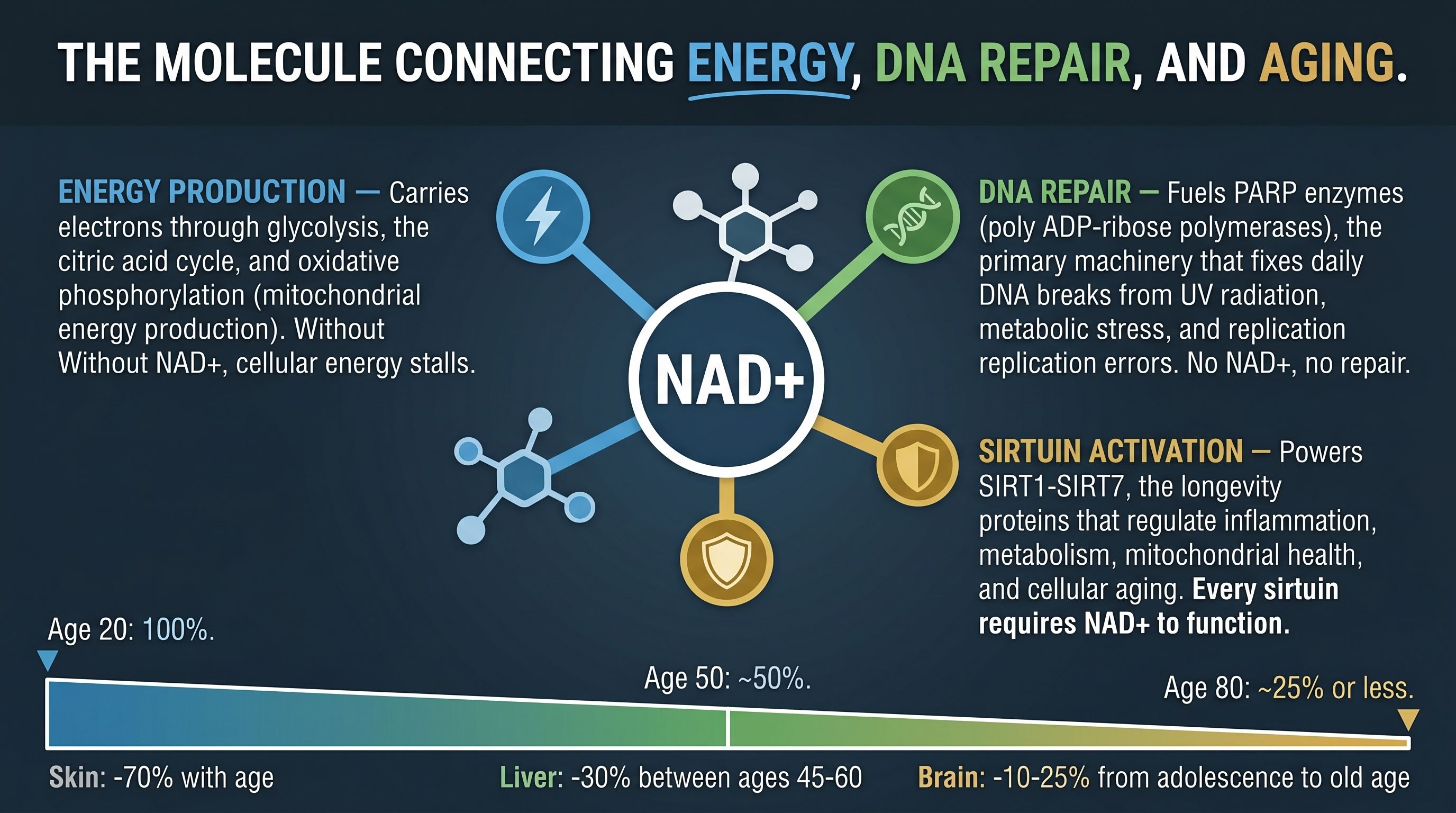
By the time you are 50, you have roughly half as much of it as you did at 20.
By the time you are 80, you may have less than a quarter.
The scientific community spent decades dismissing NAD+ as a simple metabolic middleman. Then researchers started asking what happened when it ran out. The answer is behind most of what we call aging.
Today's Issue
Main Topic: What NAD+ actually does, why it declines, what the science says about whether NMN and NR supplements can restore it, what the clinical trials actually found, and what is honestly worth doing
Subtitles:
What NAD+ does and why losing it matters
Why NAD+ declines: the vicious cycle nobody talks about
NMN and NR: the two supplements the longevity industry is built on
What the clinical trials actually found: honest results
What is worth doing and what the evidence does not yet support
Abstract: NAD+ (nicotinamide adenine dinucleotide) is a coenzyme in every cell that powers energy production, activates sirtuins (the longevity proteins that regulate DNA repair and inflammation), and fuels PARP enzymes (the primary DNA damage repair machinery). It declines roughly 50% by midlife through a vicious cycle: DNA damage activates PARPs that consume NAD+, reducing sirtuin activity, impairing mitochondria, and generating more damage. CD38, an enzyme that degrades NAD+ and rises with age and chronic inflammation, compounds the drain further. NMN (nicotinamide mononucleotide) and NR (nicotinamide riboside) are precursor supplements the body converts into NAD+ inside cells. In animal models, NMN restored insulin sensitivity, lipid profiles, and mitochondrial function systemically. Human trials consistently raise blood NAD+ significantly, with NR achieving a 139% increase in one double-blind trial. However, most human trials are small (20-60 participants) and short (6-12 weeks), and have not yet confirmed clear functional anti-aging benefits. Exercise, fasting, and reducing chronic inflammation are the most evidence-backed ways to raise NAD+. Supplements are safe at standard doses and reliably raise blood NAD+, but the functional human evidence is still being established. The honest current position: NAD+ precursors raise blood NAD+, animal models are compelling, human functional data is promising but not yet conclusive, and the supplements are safe at standard doses.
1,000+ Proven ChatGPT Prompts That Help You Work 10X Faster

ChatGPT is insanely powerful.
But most people waste 90% of its potential by using it like Google.
These 1,000+ proven ChatGPT prompts fix that and help you work 10X faster.
Sign up for Superhuman AI and get:
1,000+ ready-to-use prompts to solve problems in minutes instead of hours—tested & used by 1M+ professionals
Superhuman AI newsletter (3 min daily) so you keep learning new AI tools & tutorials to stay ahead in your career—the prompts are just the beginning
1. What NAD+ Does and Why Losing It Matters ⚡🧬
Think of NAD+ as the molecule that keeps your cells honest.
It sits at the intersection of three of the most important biological processes in your body.
Energy production.
Every time your cells burn food for fuel, NAD+ is the molecule that carries the electrons through the process.
It is essential for all three stages of energy production (glycolysis, citric acid cycle, and oxidative phosphorylation). Without NAD+, these processes stall.
DNA repair.
Every day, your DNA accumulates thousands of small breaks and errors from UV radiation, metabolic byproducts, and simple replication mistakes. The primary repair machinery, a family of enzymes called PARPs (poly ADP-ribose polymerases), runs entirely on NAD+.
No NAD+, no repair. Unrepaired DNA damage accumulates, cells malfunction, and cancer risk rises.
Sirtuin activation.
Sirtuins are a family of seven proteins (SIRT1 through SIRT7) sometimes called longevity enzymes.
They regulate gene expression, reduce inflammation, maintain mitochondrial health, and respond to caloric restriction and fasting.
Every single sirtuin requires NAD+ to function. Without it, they go silent.
The common thread: NAD+ does not just do one thing. It connects energy, DNA integrity, and cellular aging into a single system. When it drops, everything connected to it drops with it.
💡 Fun Fact: NAD+ was first discovered in 1906 by Arthur Harden, who noticed that something in boiled yeast extract made fermentation run faster. He had no idea he had found the molecule that sits at the center of aging biology. It took another century to understand what it actually did.
2. Why NAD+ Declines: The Vicious Cycle Nobody Talks About 🔄📉
NAD+ does not just passively disappear with age. It gets consumed.
Here is how the cycle works.
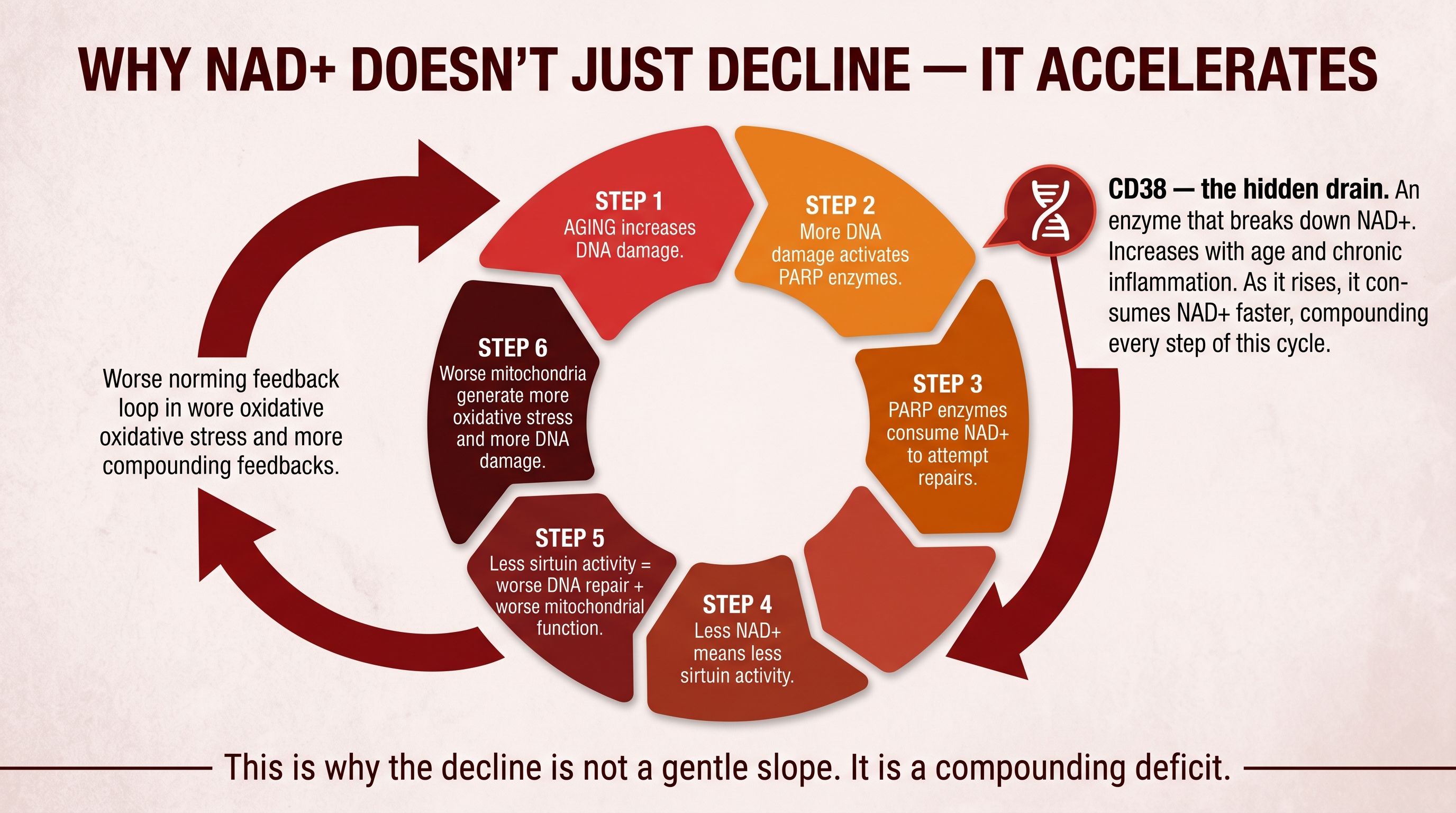
As you age, DNA damage accumulates faster than it is repaired. More damage means more PARP activation. More PARP activation means more NAD+ consumed.
Less NAD+ means less sirtuin activity. Less sirtuin activity means worse DNA repair and worse mitochondrial function.
Worse mitochondrial function generates more oxidative stress (the chemical byproducts of energy production that damage cells).
More oxidative stress means more DNA damage.
Round and round.
There is a second drain that receives even less attention: an enzyme called CD38.
CD38 is an NADase, meaning its job is to break down NAD+.
CD38 activity increases dramatically with age and with chronic low-grade inflammation (the persistent mild inflammatory state that accumulates in older adults, sometimes called "inflammaging").
As CD38 rises, it consumes NAD+ at an increasing rate, compounding the decline from PARP activity.
This is why the NAD+ decline is not a gentle slope. It is a compounding deficit.
3. There are three ways to supplement this system, and they work at different points in the same pathway.
NAD+ directly. Yes, NAD+ can be taken as a supplement. Liposomal and sublingual forms (delivery formats that bypass digestion and absorb through cell membranes more efficiently) have emerged as a way to raise NAD+ levels without relying on conversion steps. For people who want the most direct approach, this is it.
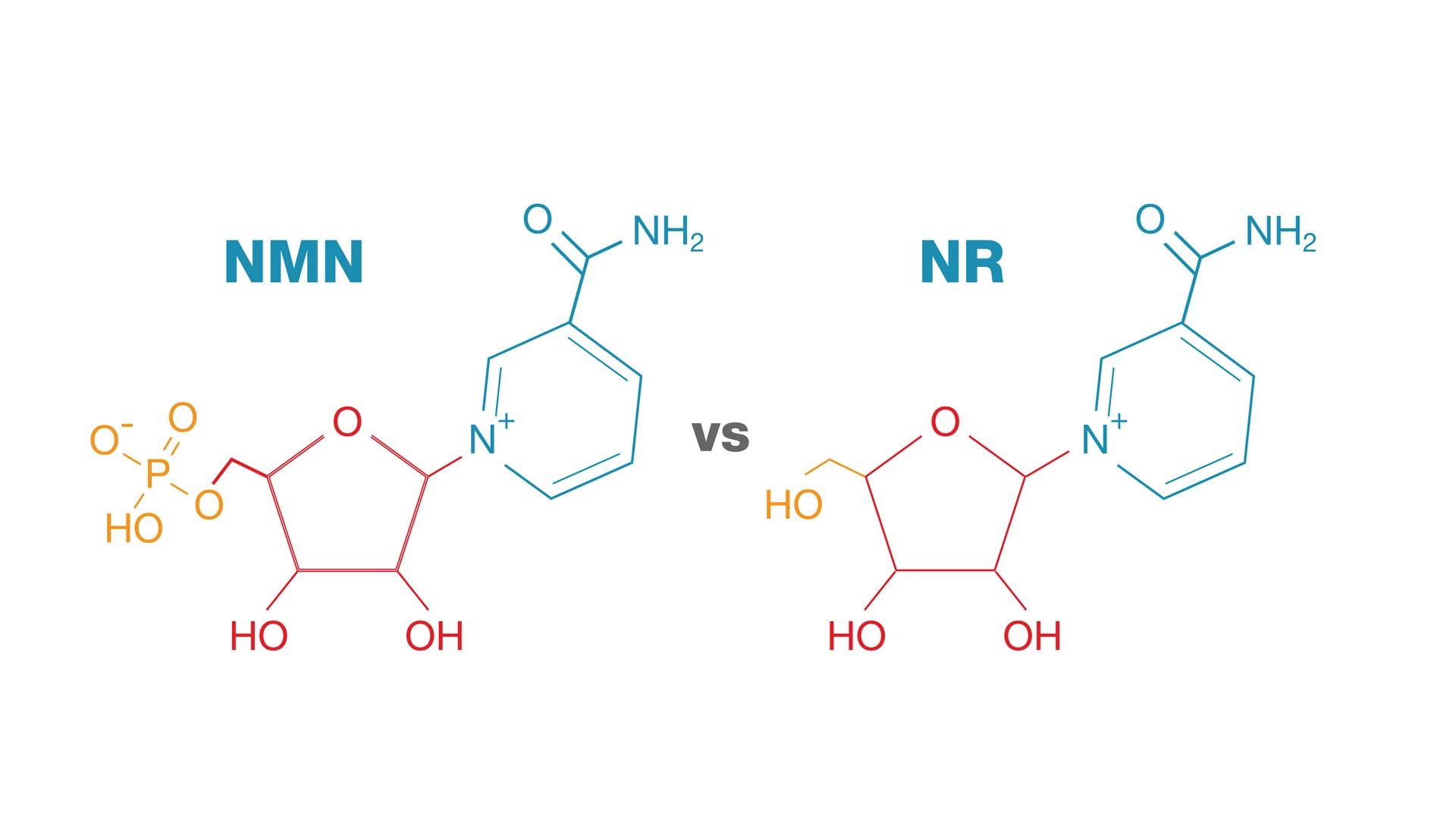
NMN (nicotinamide mononucleotide) is one step away from NAD+ in the biosynthetic pathway. It enters cells via a dedicated transporter and converts to NAD+ rapidly.
It is the form David Sinclair, the Harvard longevity researcher who has done more than anyone to bring NAD+ into public awareness, has publicly taken himself for years.
NR (nicotinamide riboside) sits one step further back, converting first to NMN and then to NAD+. It has been available longer than NMN, has the largest body of human clinical trial data of the three, and has been shown to raise blood NAD+ by up to 139% in double-blind trials.
All three are derived from niacin (vitamin B3), which raises NAD+ but causes an uncomfortable flushing reaction (a sudden wave of skin redness and heat) at the doses needed.
NAD+, NMN, and NR do not cause this.
4. What Is Actually Worth Doing ✅🏃
The most evidence-backed ways to raise NAD+ do not require a supplement at all.
Exercise reduces CD38 activity, reduces the inflammatory drain on NAD+, and upregulates NAMPT (the enzyme that produces NAD+ from scratch inside cells). Both aerobic and resistance exercise raise NAD+ levels measurably. This is one of the mechanisms behind exercise's documented anti-aging effects.
Caloric restriction and intermittent fasting shift the cellular energy balance in a direction that activates sirtuins and increases NAD+ availability. This is the mechanism behind one of the oldest and most replicated findings in longevity biology: calorie restriction extends healthy lifespan across virtually every species tested.
Reducing chronic inflammation decreases CD38 activity, the major NAD+ drain. The same lifestyle factors that drive inflammation (poor sleep, sedentary behavior, processed food, obesity) are directly depleting your NAD+.
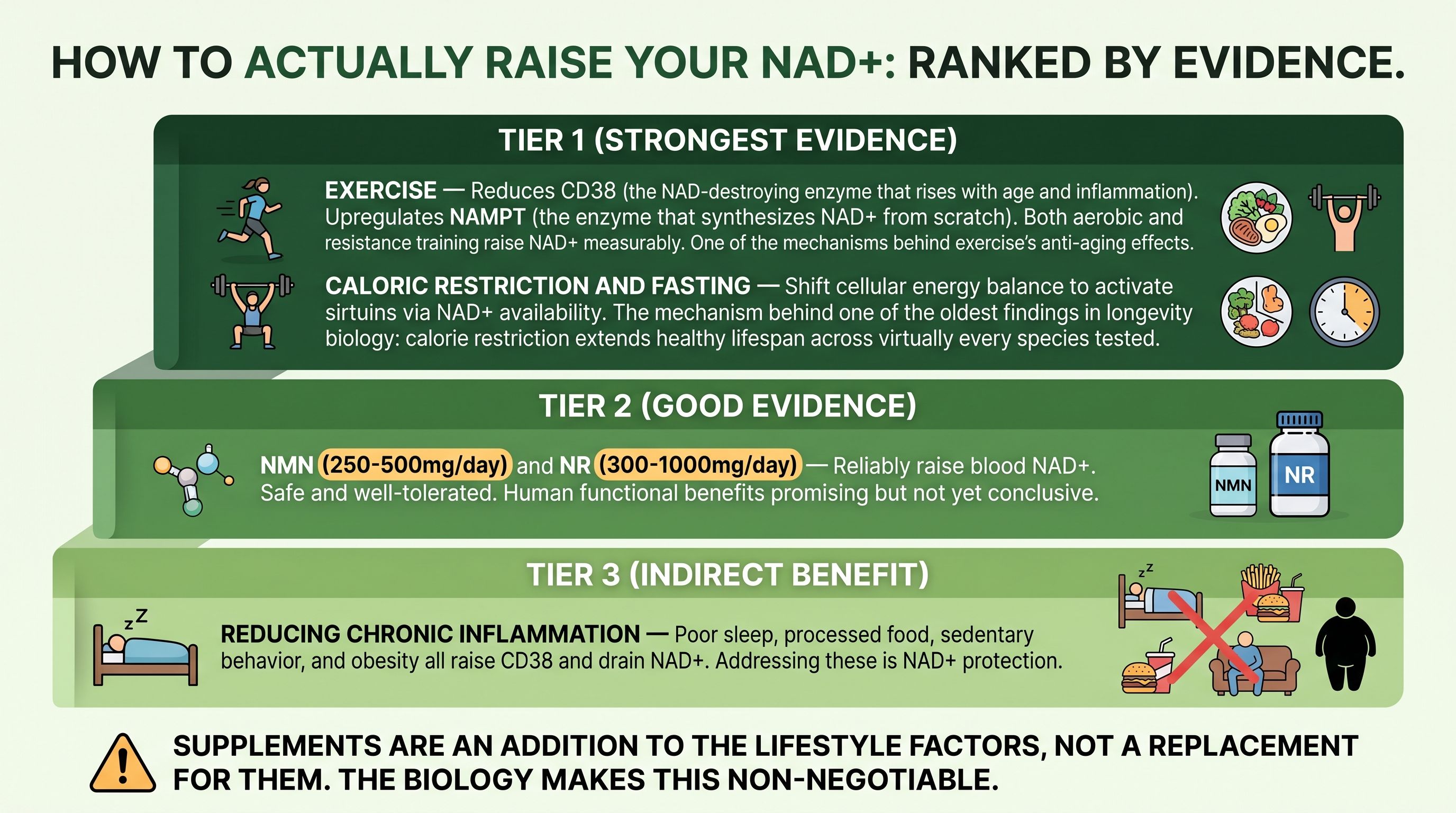
On supplementation: if you are considering NMN or NR, the evidence supports their safety. Standard doses are 250-500mg/day for NMN, 300-1000mg/day for NR. They reliably raise blood NAD+. Whether that translates into meaningful functional benefits in humans over the long term is what the next generation of trials is designed to answer.
The one thing the science does not support: taking NMN or NR as a substitute for the lifestyle factors that raise NAD+ most reliably. The supplements are being studied as an addition to, not a replacement for, what exercise and diet already do.
Takeaways
NAD+ is a coenzyme in every cell that powers energy production, activates sirtuins (the longevity proteins SIRT1-SIRT7 that regulate DNA repair, inflammation, and mitochondrial health), and fuels PARP DNA repair enzymes; it declines approximately 50% by midlife and further with age through a vicious cycle where DNA damage consumes NAD+ via PARP activation, reducing sirtuin function, impairing mitochondrial health, generating more damage, while the enzyme CD38 (which degrades NAD+ and rises with age and chronic inflammation) compounds the drain further.
NMN and NR are NAD+ precursor supplements that consistently and significantly raise blood NAD+ levels in human trials. NR raised blood NAD+ by 139% in one double-blind trial, and both are safe and well-tolerated at standard doses. Animal studies show striking systemic rejuvenation effects from NAD+ restoration, but human clinical trials have so far been too small and too short to confirm clear functional anti-aging benefits, with most trials running 6-12 weeks in 20-60 participants, and larger longer trials currently underway.
The most evidence-backed ways to raise NAD+ are lifestyle-based: exercise reduces CD38 activity and upregulates NAD+ production enzymes, caloric restriction and fasting activate sirtuins through NAD+ availability, and reducing chronic inflammation cuts the primary NAD+ drain, making supplementation with NMN or NR a potentially useful addition to these interventions rather than a substitute for them, at standard doses of 250-500mg/day for NMN and 300-1000mg/day for NR.
Learn how to code faster with AI in 5 mins a day

You're spending 40 hours a week writing code that AI could do in 10.
While you're grinding through pull requests, 200k+ engineers at OpenAI, Google & Meta are using AI to ship faster.
How?
The Code newsletter teaches them exactly which AI tools to use and how to use them.
Here's what you get:
AI coding techniques used by top engineers at top companies in just 5 mins a day
Tools and workflows that cut your coding time in half
Tech insights that keep you 6 months ahead
Sign up and get access to the Ultimate Claude code guide to ship 5X faster.
Feedback & Sponsorship
What'd you think of this week's newsletter? Hit reply to let us know. Did we crush it? Blow your mind? We read every response.
Want your brand in front of hundreds of thousands of readers? Contact us for sponsorship opportunities [email protected]
Want more where that came from? Head to our website
Reply