- Aeviva
- Posts
- This Is What a Nuclear Weapon Actually Does to Your Body
This Is What a Nuclear Weapon Actually Does to Your Body
Most people think they know. They do not. Here is the science, zone by zone, and what actually gives you a chance of surviving.
Estimated Read Time: 6 minutes
A nuclear weapon does not kill you in one way.
It kills you in four.
Simultaneously, in cascading waves, each one designed by physics to reach further than the last.
The fireball vaporizes what is closest. The blast wave destroys what is further. The thermal flash burns what is further still. And the fallout, the invisible one, drifts for kilometers on the wind and keeps killing for days, weeks, and years.
Most people have a vague, movie-shaped idea of what a nuclear detonation looks like.
This newsletter is about what it actually does, organ by organ, cell by cell, and what the science says about what you can do to survive if you are far enough from the center.
Today's Issue
Main Topic: The four mechanisms by which a nuclear weapon damages and kills the human body, what each one does at the biological level, how far each effect reaches, and the evidence-based actions that meaningfully improve survival chances for those outside the immediate kill zone
Subtitles:
The four waves: how a nuclear weapon actually kills
Zone by zone: what happens to your body at each distance
Radiation sickness: what ionizing radiation does inside your cells
Fallout: the slow killer most people do not understand
What actually protects you: the science of shelter, timing, and decisions
Abstract: A nuclear detonation releases energy through four primary mechanisms: the fireball and direct blast (approximately 50% of total energy), thermal radiation or heat flash (approximately 35% of energy), ionizing radiation (approximately 5% prompt, 10% residual/fallout). Within the immediate kill zone (radius varies by weapon yield, but approximately 1-2km for a 10-kiloton weapon), virtually everything is vaporized or destroyed beyond survivability. The blast wave, a sudden massive increase in air pressure (measured in kilopascals, or kPa) traveling faster than the speed of sound, causes direct internal injury through pressure differentials: lungs and air-containing abdominal organs are particularly vulnerable, rupturing at overpressures of approximately 70 kPa; eardrums rupture at 22-130 kPa; the pressure wave also accelerates debris (glass shards, structural materials) to lethal velocities. Thermal radiation at ranges of up to 20 miles from a large thermonuclear device causes full-thickness burns on exposed skin, ignites clothing and combustible materials, and can cause flash blindness, in which the initial brilliant light permanently damages the retina, even in people not looking directly at the detonation. Ionizing radiation damages the human body by stripping electrons from atoms within cells (hence "ionizing"), breaking DNA strands, and disrupting cellular replication. The dose is measured in Gray (Gy): below 1 Gy, most people recover with minimal symptoms; at 2-6 Gy, acute radiation syndrome (ARS) causes bone marrow destruction, immune collapse, and bleeding; at 6-10 Gy, gastrointestinal destruction becomes the primary mechanism of death within 7-14 days; at 10-50 Gy, death occurs within 24-48 hours from central nervous system failure. Radioactive fallout, the descent of contaminated particles lofted into the atmosphere, poses the primary radiation risk to people kilometers away from the detonation. Critically, 90% of fallout radiation decays within the first 72 hours, meaning shelter timing is the single most important survival variable outside the immediate kill zone. Being in a basement of a brick or concrete building for the first 24-72 hours reduces radiation exposure by a factor of 10-20 compared to being outdoors.
Go from AI overwhelmed to AI savvy professional

AI will eliminate 300 million jobs in the next 5 years.
Yours doesn't have to be one of them.
Here's how to future-proof your career:
Join the Superhuman AI newsletter - read by 1M+ professionals
Learn AI skills in 3 mins a day
Become the AI expert on your team
1. The Four Waves: How a Nuclear Weapon Actually Kills 💥⚡
When a nuclear weapon detonates, it releases an amount of energy roughly one million times greater than a conventional chemical explosion of the same physical size.
That energy is distributed in four ways.
Wave 1: The fireball. Within milliseconds, temperatures at the center reach levels comparable to the surface of the sun. Everything within a certain radius is vaporized. Not destroyed. Not burned. Vaporized into plasma.
Wave 2: The blast wave. The rapidly expanding superheated gas pushes outward through the surrounding air, creating a sudden massive increase in air pressure that travels faster than the speed of sound.
This overpressure (the term for pressure above normal atmospheric levels, measured in kilopascals or kPa) crushes structures, ruptures internal organs, and accelerates debris to lethal speeds. A few pounds per square inch of overpressure is enough to destroy a typical wooden house.
Wave 3: The thermal flash. The fireball radiates intense heat as visible light, infrared (heat), and ultraviolet radiation. This thermal flash travels at the speed of light, arrives before the blast wave, and accounts for about 35% of the weapon's total energy. It causes burns, ignites fires, and at large weapon yields can start fires up to 20 miles away. Two-thirds of survivors injured at Hiroshima showed evidence of flash burns.
Wave 4: Fallout. The fireball lofts massive amounts of pulverized material, soil, and radioactive fission products (the unstable atoms created during the nuclear reaction) high into the atmosphere. As this cloud cools, contaminated particles descend back to earth, carried by wind, over an area potentially hundreds of kilometers from the detonation.
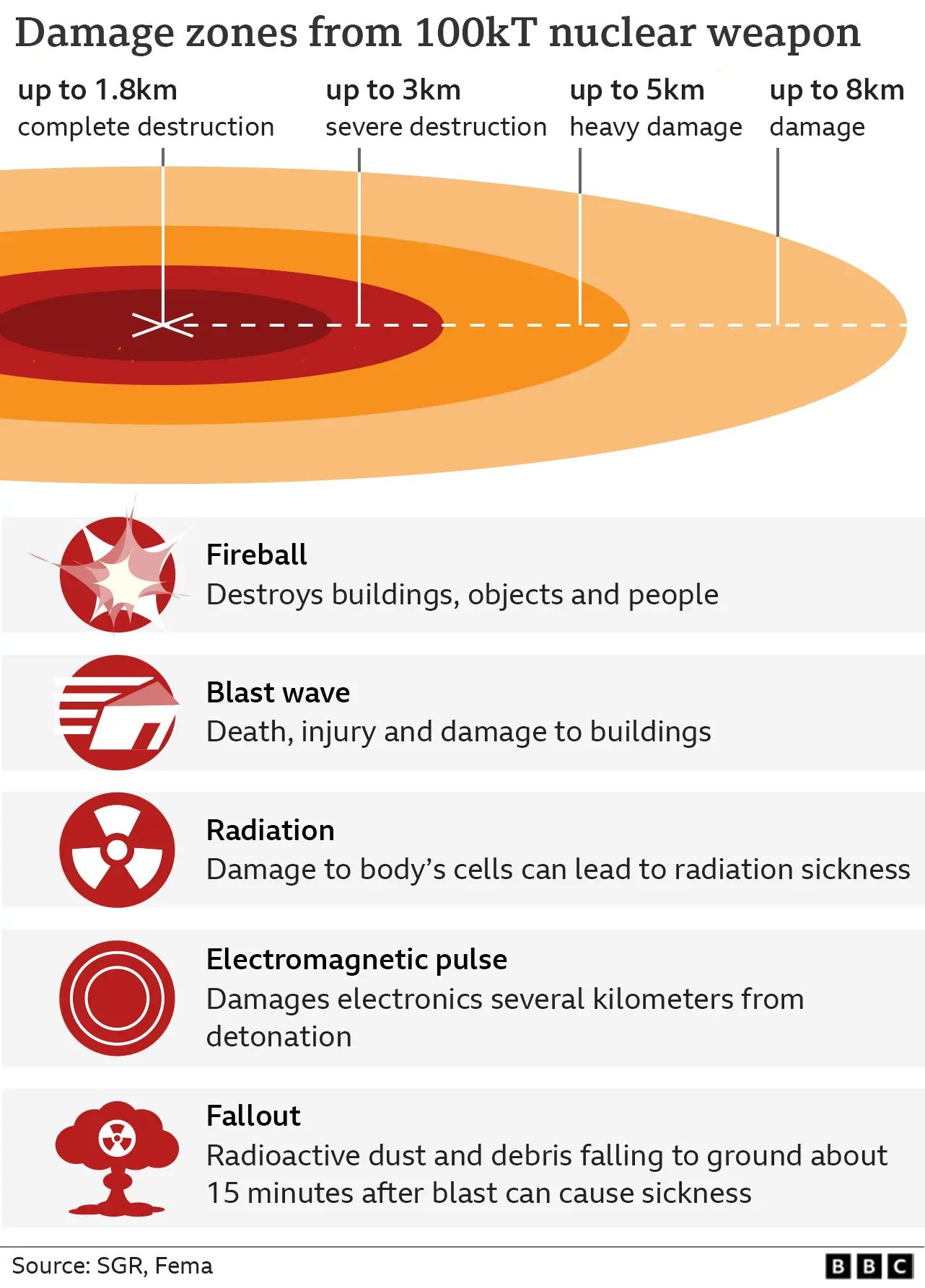
source: BBC
💡 Fun Fact: The pattern of burns on a Hiroshima survivor's skin directly mirrored the pattern of her clothing. White fabric reflects infrared light; dark fabric absorbs it. The skin under dark fabric burned. The skin under white fabric did not. A single piece of clothing determined whether tissue lived or died.
2. Zone by Zone: What Happens to Your Body at Each Distance 📍☢️
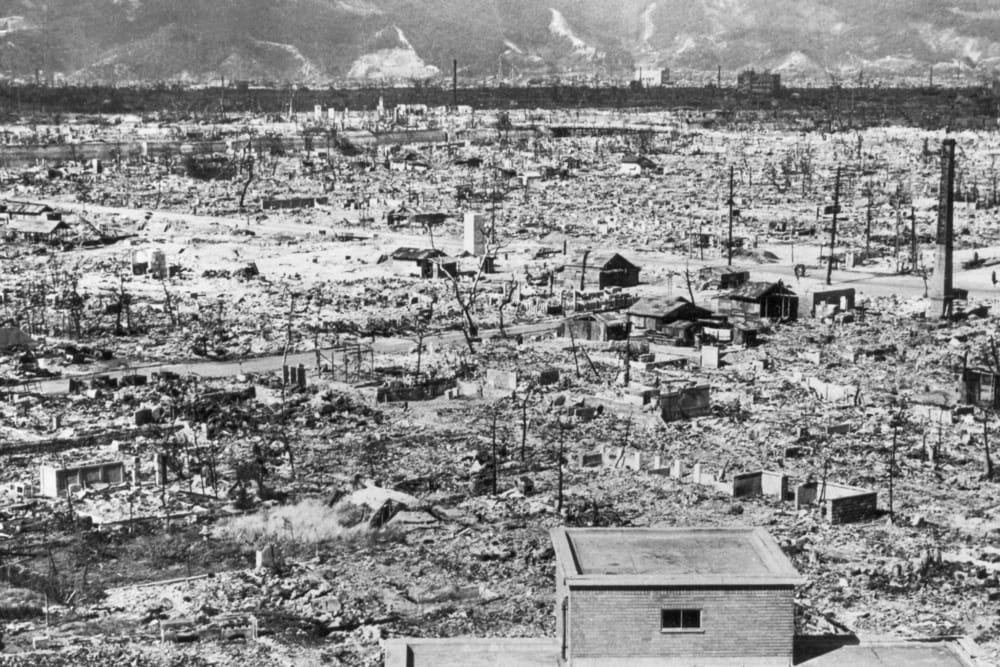
The effects of a nuclear weapon depend heavily on the weapon's yield (its explosive power, measured in kilotons or megatons), the height of the detonation, and the local geography. The figures below use a 10-kiloton weapon, roughly similar to the Hiroshima bomb, as a reference point.
Zone 1: Ground zero, 0-0.5km radius
Nothing survives. The fireball temperature vaporizes all matter. There is no meaningful medical discussion of injury here.
Zone 2: 0.5-2km radius
The blast wave arrives at pressures sufficient to collapse buildings entirely. Lungs rupture from the internal pressure differential (the pressure wave moves through the body, but air-containing organs, like lungs and bowel, respond differently to solid tissue, tearing at the interface).
Eardrums rupture. The body is thrown against surfaces and debris is driven through it at high velocity. Thermal burns are full-thickness (the most severe category, destroying all skin layers) on all exposed skin. Radiation dose at this range is lethal. Most people in this zone do not survive.
Zone 3: 2-5km radius
Blast wave still causes serious structural damage and significant internal injury. Thermal burns are severe on exposed skin. Flash blindness (temporary or permanent damage to the retina from the initial light flash) is likely even for people who are not looking at the detonation.
Note: reflected and scattered light is sufficient to cause flash blindness, you do not need direct line of sight. Radiation dose is potentially lethal without shelter. Fires spreading from thermal ignition become a serious secondary hazard.
Zone 4: 5-20km radius (thermal flash range)
At this range, the primary immediate threat shifts from blast to thermal effects. Burns on exposed skin are still possible at up to 20 miles for large thermonuclear weapons. The blast wave has weakened significantly but can still shatter glass and throw debris. Fallout becomes the dominant ongoing threat. Survival probability increases substantially with shelter.
Zone | Primary Threat | Survival Odds Without Shelter | With Shelter |
|---|---|---|---|
0-0.5km | Fireball/vaporization | Zero | Zero |
0.5-2km | Blast + radiation | Very low | Very low |
2-5km | Blast + burns + radiation | Low | Improved |
5-20km | Thermal + fallout | Moderate | Significantly improved |
20km+ | Fallout only | High | Very high with early shelter |
3. Radiation Sickness: What Ionizing Radiation Does Inside Your Cells 🧬💀
This is the mechanism most people picture but understand least.
Ionizing radiation, the kind emitted by a nuclear detonation and its fallout, works by stripping electrons from atoms inside your body's cells. The word "ionizing" simply means it has enough energy to knock electrons out of atoms, creating charged ions (unstable atoms). This is what makes it biologically dangerous.
When this happens inside a cell's DNA, it breaks the DNA strand.
Your body has repair mechanisms for this. Small doses of ionizing radiation happen naturally all the time (from cosmic rays, radon gas, medical X-rays) and your cells handle it without issue.
The problem is dose. When the dose is too high, too fast, the damage outruns the repair mechanisms.
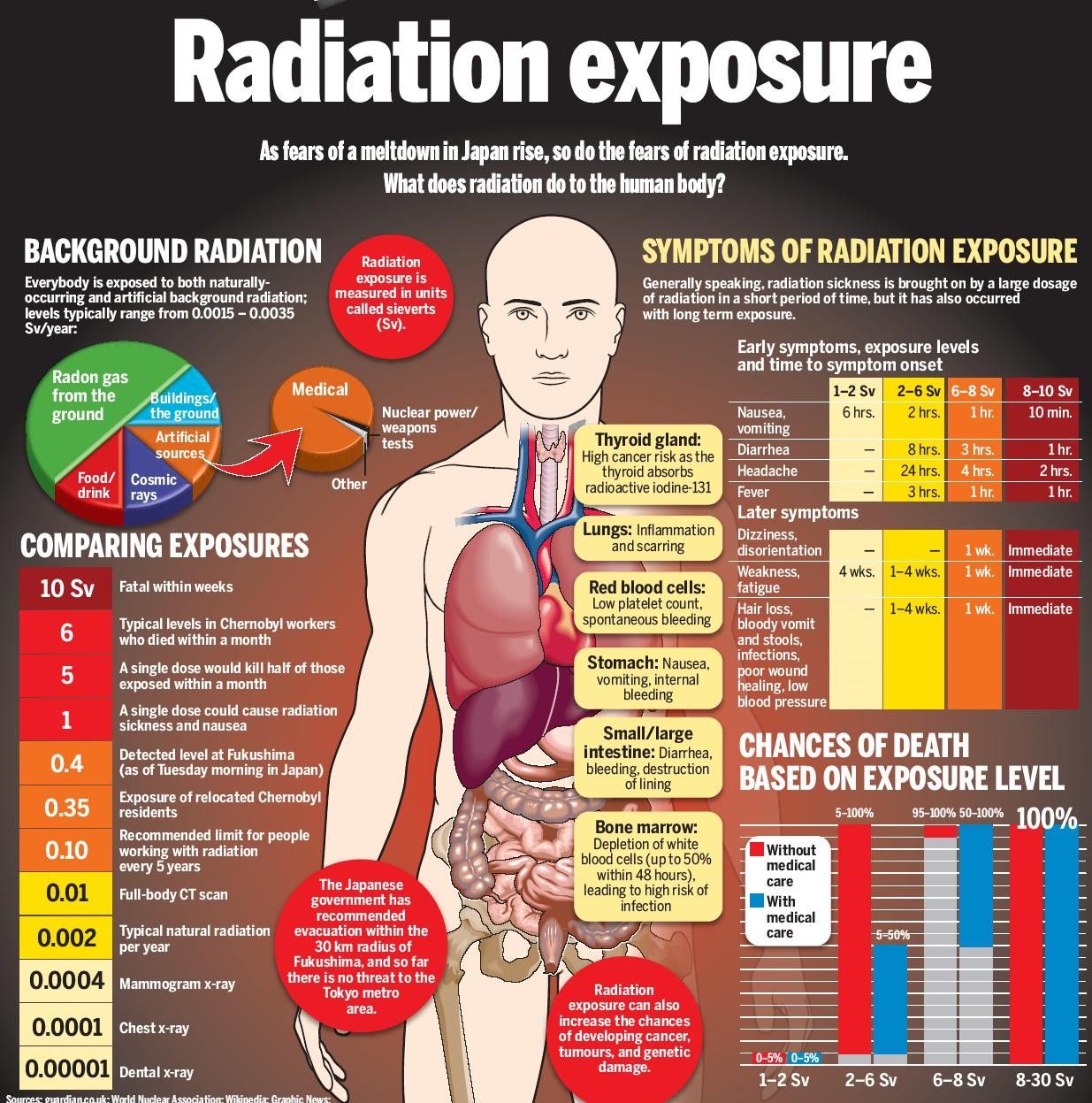
Acute Radiation Syndrome (ARS) is what happens when the whole body receives a high enough dose in a short enough time. It progresses through four stages:
Below 1 Gray (Gy, the unit measuring absorbed radiation dose): Most people experience little or no symptoms. Minor changes in blood cell counts. Full recovery likely.
1-2 Gy: Nausea, vomiting, fatigue beginning within hours. The bone marrow (the tissue inside bones that produces blood cells, including white blood cells that fight infection and platelets that allow blood to clot) starts to be suppressed. Recovery is likely but takes weeks.
2-6 Gy: This range causes serious bone marrow destruction. White blood cell counts collapse, making the body unable to fight infection. Platelet counts drop, causing uncontrolled bleeding. Without medical treatment, mortality ranges from roughly 1% at the low end to 99% at the high end of this range.
6-10 Gy: The gastrointestinal tract becomes the primary site of damage. The lining of the intestines (the cells that form the barrier between your gut contents and your bloodstream) is destroyed. The gut, which normally keeps bacteria contained, begins leaking bacteria into the bloodstream, causing lethal infection.
Death typically occurs within 7-14 days from fluid loss, electrolyte imbalance, and systemic infection. There is no effective treatment at this range.
10-50+ Gy: Central nervous system failure becomes the dominant mechanism. Severe disorientation, seizures, cardiovascular collapse. Death within 24-48 hours. No treatment is possible.
4. Fallout: The Slow Killer Most People Do Not Understand ☁️🌬️
Here is the part that matters most for anyone outside the immediate kill zones.
Fallout is not a cloud of green gas. It is not a visible fog. It is particles, ranging from fine dust to sand-sized grains, that have been made radioactive by the nuclear reaction and lofted into the atmosphere by the fireball. As they cool and descend, they deposit on surfaces, rooftops, soil, clothing, and skin.
The radiation from fallout is primarily gamma radiation (high-energy electromagnetic waves that penetrate deeply into tissue, similar to very powerful X-rays) and beta radiation (energetic electrons that penetrate a few millimeters into skin, causing surface burns).
The fallout does not arrive instantly. Depending on distance and wind speed, fallout may take 10 minutes to several hours to arrive at your location after the detonation. This window is critical.
The most important fact about fallout that almost nobody knows: radioactive fallout decays extremely rapidly. Approximately 90% of the dangerous radiation from fresh fallout dissipates within the first 72 hours. The rule of thumb used by emergency planners is called the "7-10 rule": for every sevenfold increase in time after the detonation, radiation levels decrease by a factor of ten.
This means: getting inside a sturdy building within the first 10-15 minutes, before fallout arrives, and staying there for 24-72 hours, dramatically reduces your total radiation dose compared to being outdoors.
5. What Actually Protects You: The Science of Shelter, Timing, and Decisions 🏗️✅
The single most evidence-backed survival action for anyone outside the immediate kill zones is this:
Get inside. Stay inside. Stay tuned.
This is not vague reassurance. It is physics. Here is why it works.
Shielding reduces radiation exposure. Building materials (concrete, brick, soil) absorb gamma radiation. The more mass between you and the fallout on the ground and roof, the lower your dose.
Outdoors (no shelter): Protection factor of 1 (baseline)
Frame building, first floor: Protection factor of 2-3
Brick building, first floor: Protection factor of 10
Basement of a brick or concrete building: Protection factor of 10-20
This means being in a concrete basement reduces your radiation exposure by up to 20 times compared to being outside.
The best shelter locations inside a building: basement (furthest from fallout deposited on ground and roof), central rooms away from windows and exterior walls, middle floors of multi-story buildings (above the fallout on the ground, below the fallout on the roof).
Timing is everything. Emergency planners specify that you typically have 10 minutes or more after a detonation to reach a shelter before fallout arrives at most distances. Use that window deliberately. Do not go outside to retrieve belongings or reunite with people. A few minutes of extra outdoor exposure after fallout arrives can significantly increase your total dose.
Decontamination. If you were outdoors when fallout arrived, remove your outer clothing before entering your shelter. Removing outer clothing eliminates roughly 80% of radioactive contamination from your body. Shower with soap and water immediately. Do not use conditioner (it binds radioactive particles to hair). Blow your nose, gently wipe your eyelids and ears.
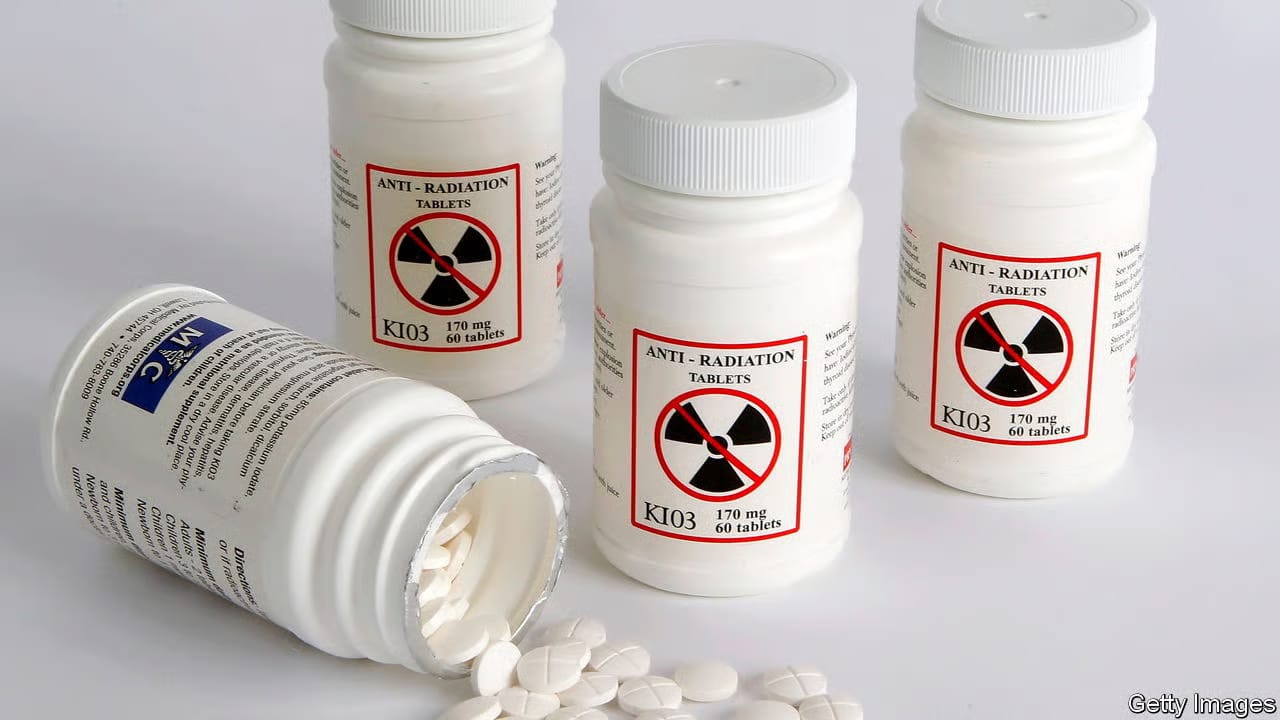
Potassium iodide (KI). This is the supplement you may have heard of in the context of nuclear emergencies. It works by flooding your thyroid gland with non-radioactive iodine, blocking the absorption of radioactive iodine (I-131) from fallout. It protects only the thyroid, only against radioactive iodine, and only when taken before or very shortly after exposure. It does not prevent ARS, does not protect other organs, and should only be taken when directed by public health authorities. Adults over 40 should only take it under medical direction. It is not a general radiation antidote. Think of it as one narrow protection, not a survival pill.
What does not protect you:
Ordinary surgical or cloth masks do not stop gamma radiation. They can reduce inhalation of fallout particles, which is useful, but they are not primary protection. Iodized table salt is not a substitute for KI tablets and consuming enough table salt to have any effect would be lethal. Most common misconceptions about nuclear survival involve either catastrophizing (nothing helps) or trivializing (any shelter is enough). The reality is that distance, shelter quality, timing, and staying informed are the four variables that determine survivability for people in the outer zones.
Takeaways
A nuclear detonation kills through four sequential mechanisms: the fireball (vaporizes everything in the immediate zone), the blast wave (overpressure that ruptures lungs and air-containing organs at 70 kPa, destroys buildings, drives debris at lethal velocity), the thermal flash (burns exposed skin up to 20 miles from large weapons, causes flash blindness even without direct line of sight), and fallout (radioactive particles descending over hours to days, the primary radiation threat for people outside the immediate kill zone), with approximately 35% of total weapon energy delivered as thermal radiation and fallout representing the dominant ongoing hazard for the vast majority of affected people.
Ionizing radiation damages human cells by breaking DNA strands; Acute Radiation Syndrome (ARS, the medical term for radiation sickness) progresses from manageable at under 1 Gray (Gy, the unit of absorbed radiation dose) to bone marrow destruction and immune collapse at 2-6 Gy, to gastrointestinal lining destruction and death within 7-14 days at 6-10 Gy, to central nervous system failure and death within 24-48 hours above 10 Gy, and critically, 90% of dangerous fallout radiation decays within the first 72 hours, making early shelter timing the single most impactful survival variable for anyone outside the immediate kill zones.
Getting inside a brick or concrete building within 10 minutes of detonation, moving to the basement or central interior rooms (away from exterior walls, roof, and windows), and staying there for 24-72 hours reduces radiation exposure by a factor of 10-20 compared to being outdoors; removing outer clothing before entering shelter eliminates approximately 80% of radioactive contamination; potassium iodide (KI) pills protect only the thyroid against one specific type of radioactive material and are not a general radiation antidote, and the three variables that determine survival outside the fireball zone are distance from the detonation, the quality and timing of sheltering, and staying informed rather than making uninstructed movements outdoors.
Feedback & Sponsorship
What'd you think of this week's newsletter? Hit reply to let us know. Did we crush it? Blow your mind? We read every response.
Want your brand in front of hundreds of thousands of readers? Contact us for sponsorship opportunities [email protected]
Want more where that came from? Head to our website
Reply