- Aeviva
- Posts
- The Wellness Lies Instagram Still Sells Us
The Wellness Lies Instagram Still Sells Us
Detox teas, alkaline water, collagen gummies, celery juice. The wellness industry is worth $4.5 trillion and much of it is built on claims science has already debunked. Here's what the research actually says

In partnership with

Estimated Read Time: 6 minutes
The wellness aesthetic has had a rebrand. It's no longer crash diets and calorie counting. Now it's matcha lattes, morning routines, and "nourishing your body from the inside out."
The packaging changed. The pseudoscience didn't.
Underneath the muted neutrals and clean-girl captions, the same pattern repeats: take this product, follow this protocol, and you'll finally unlock the health you've been missing. The global wellness market hit $4.5 trillion in 2024, and a staggering portion of it is selling you solutions to problems your body already solves on its own.
Today's Issue
Main Topic: Five of the most persistently viral wellness claims on Instagram, what the actual science says about each one, why they keep spreading despite the evidence, and how to tell the difference between a legitimate health trend and an expensive placebo
Subtitles:
The detox lie: why your body doesn't need a cleanse
Alkaline water: the $4 bottle solving a problem that doesn't exist
Collagen supplements: the one Instagram trend that's actually complicated
Celery juice and "superfood" singles: how single ingredients get weaponized
The wellness identity trap: when health becomes a personality (and a purchase)
Abstract: The wellness industry capitalizes on misunderstanding of human physiology to sell products that duplicate functions the body already performs. Detoxification is a continuous hepatic and renal process: the liver performs phase I (cytochrome P450 oxidation, reduction, hydrolysis of toxins) and phase II (conjugation making toxins water-soluble for excretion) detoxification, while kidneys filter 180 liters of blood per day producing 1 to 2 liters of urine containing waste. No juice cleanse, detox tea, or supplement has been demonstrated to enhance these processes in healthy individuals. Detox teas frequently contain senna or other laxatives (stimulant laxatives causing intestinal contractions), producing temporary weight loss that is entirely water and stool content, not fat or toxins. Alkaline water (pH 8 to 9.5 versus regular water pH 6.5 to 7.5) cannot alter blood pH, which is tightly regulated between 7.35 and 7.45 by respiratory (CO2 exhalation) and renal (bicarbonate excretion) buffering systems; deviations beyond 0.1 pH units cause life-threatening acidosis or alkalosis regardless of dietary alkalinity. Oral collagen supplementation is more scientifically nuanced: 26 RCTs involving 1721 patients showed hydrolyzed collagen peptides (HC, molecular weight 3 to 6 kDa) significantly improved skin hydration and elasticity versus placebo. However, unhydrolyzed collagen (large intact protein molecules, 300 kDa) is largely broken down to amino acids during digestion and does not specifically direct collagen synthesis to skin. The critical variable is molecular weight and hydrolysis degree, not simply "collagen" as marketed. Celery juice contains no unique bioactive compound not found in whole celery and actually removes fiber (the most evidence-backed component of vegetables); no clinical trial has validated any specific celery juice health claim. The wellness identity trap describes the documented psychological phenomenon where health practices become identity markers, making people resistant to evidence that contradicts their health beliefs because accepting the evidence would threaten their self-concept.
Feel Better, Without Overthinking It

Most of us don’t need a complicated routine. We just want to feel good, stay energized, and not think too hard about it.
AG1 Next Gen is a clinically studied daily health drink that supports gut health, helps fill common nutrient gaps, and supports steady energy. One scoop in cold water replaces a multivitamin, probiotics, and more, so your routine stays simple.
Start your mornings with AG1 and get 3 FREE AG1 Travel Packs, 3 FREE AGZ Travel Packs, and FREE Vitamin D3+K2 in your Welcome Kit with your first subscription.
1. The Detox Lie: Why Your Body Doesn't Need a Cleanse 🧪🚫
Let's start with the biggest one. The word detox appears on thousands of products, protocols, and Instagram posts daily. And it's built on a fundamental misrepresentation of how the human body works.
Your body already detoxifies continuously, 24 hours a day, through two organs that are extraordinarily good at their jobs.
Your liver performs two-stage detoxification: phase I uses enzymes called cytochrome P450s to chemically modify toxins through oxidation and reduction.
No juice cleanse, no detox tea, and no activated charcoal shot enhances these processes in a healthy person. When asked "what toxins, exactly, does your cleanse remove?", no wellness brand has ever provided a specific, measurable answer, because the premise doesn't hold up.
As one registered dietitian put it: "Wellness culture views the liver and kidneys like filters in a sink that get clogged with gunk. They're not. They're dynamic, self-maintaining systems."
Detox teas are the most egregious version of this lie. Most contain senna, a stimulant laxative that causes intense intestinal contractions. The resulting rapid weight loss is entirely water and gut content. Not fat. Not toxins. And regular stimulant laxative use causes dependence, electrolyte imbalances, and can cause colitis with prolonged use.
💡 Fun Fact: The concept of detoxing the body through diet dates back thousands of years and has roots in various spiritual and medical traditions. The modern commercial detox movement, however, is almost entirely a product of 1990s wellness marketing, not medicine.
2. Alkaline Water: The $4 Bottle Solving a Problem That Doesn't Exist 💧🔬

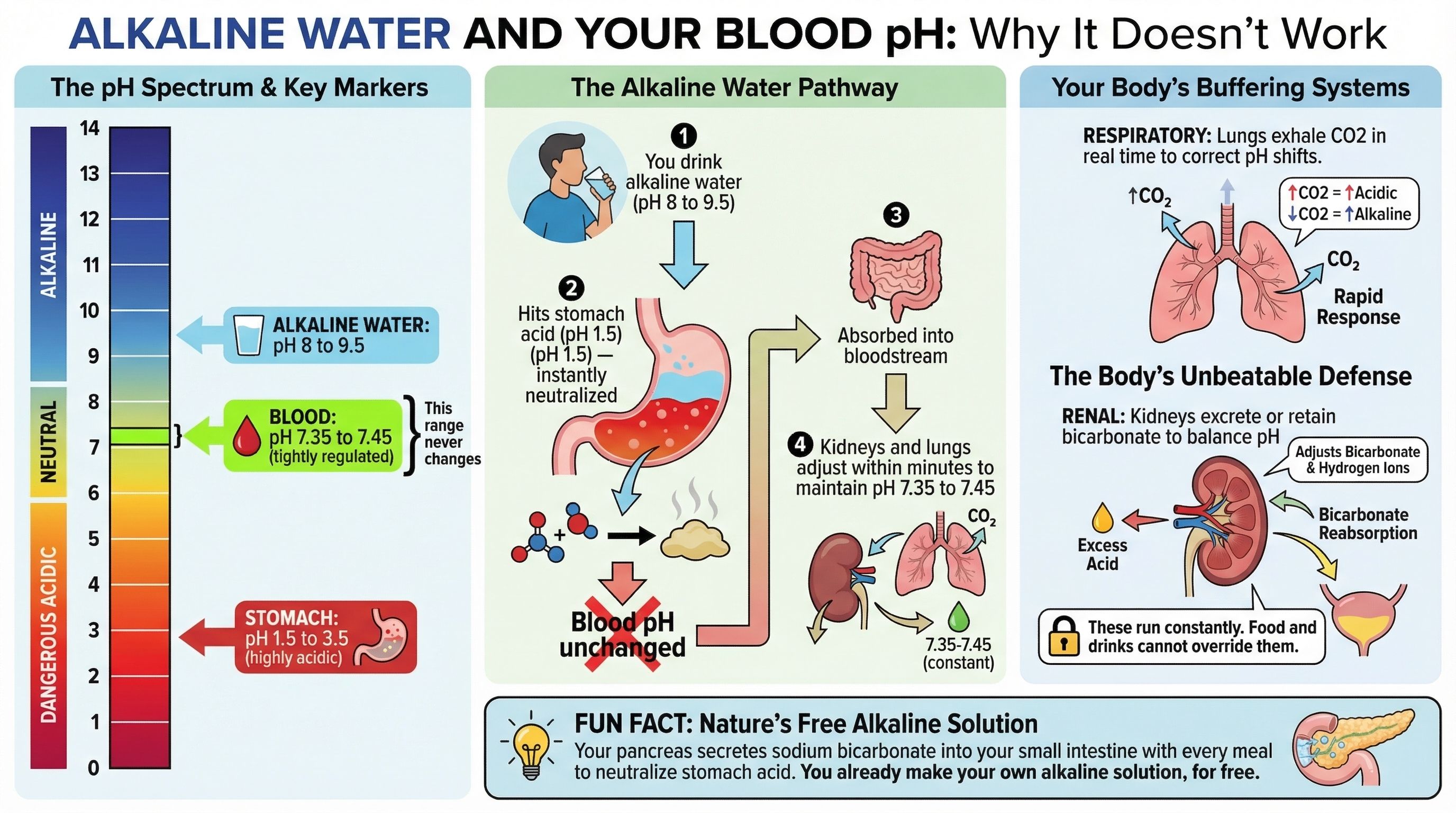
Alkaline water (typically pH 8 to 9.5, compared to regular water's pH 6.5 to 7.5) is one of the most elegantly nonsensical wellness trends because it sounds scientific.
Influencers promote it for "balancing your body's pH," "reducing acid reflux," and "boosting energy."
Here is the problem: your blood pH is not negotiable. It is maintained between an extremely narrow range of 7.35 and 7.45 by two powerful buffering systems working constantly.
Your lungs adjust CO2 exhalation in real time to maintain acid-base balance. Your kidneys regulate bicarbonate excretion to do the same.
These systems are so effective that deviations of even 0.1 pH units beyond this range trigger medical emergencies: acidosis or alkalosis, both of which can be fatal.
Drinking alkaline water does not shift your blood pH.
The moment it hits your stomach, which runs at pH 1.5 to 3.5, the difference is instantly neutralized. Even if it weren't, your respiratory and renal buffering would correct it within minutes. The food and drinks you consume simply cannot alter blood pH in a healthy person.
Claim | Reality | Verdict |
|---|---|---|
"Balances body pH" | Blood pH is tightly regulated at 7.35 to 7.45 regardless of diet | False |
"Reduces acid reflux" | Some small studies show slight symptom relief (esophageal effects, not blood pH) | Partially possible, more research needed |
"Boosts energy and hydration" | No clinical evidence of superiority to regular water | No evidence |
"Neutralizes acidity from diet" | Stomach acid (pH 1.5) neutralizes alkaline water immediately | False |
💡 Fun Fact: Your body actually produces its own alkaline compound on demand. The pancreas secretes sodium bicarbonate into the small intestine to neutralize stomach acid before food enters. You are already alkalizing yourself, for free, every time you eat.
3. Collagen Supplements: The One Instagram Trend That's Actually Complicated 💊🤔
Here's where the honest answer gets nuanced, because collagen is the rare wellness trend where the science is real, but the marketing is still misleading.
The hype is correct that oral collagen can do something useful. A meta-analysis of 26 randomized controlled trials involving 1,721 patients showed that hydrolyzed collagen (HC) supplementation significantly improved both skin hydration and elasticity compared to placebo. A separate 12-week trial showed a 44.6% decrease in collagen fragmentation in the dermis, plus a 22.7% improvement in skin elasticity and a 13.8% increase in hydration, all measured against placebo under controlled conditions.
The catch is in the form. The key term is hydrolyzed: collagen that has been broken down by enzymatic processing into short peptides with a molecular weight of 3 to 6 kDa.
These small peptides can actually be absorbed through the gut wall, reach the bloodstream, accumulate in skin tissue, and stimulate fibroblasts to produce new collagen.
Unhydrolyzed collagen (intact protein molecules at 300 kDa) is mostly broken down all the way to individual amino acids during digestion and provides no specific skin benefit beyond what any protein food would.

Most collagen gummies and "beauty collagen" powders on Instagram don't specify molecular weight, hydrolysis degree, or the peptide composition that drives the results.
The product doing the work in the clinical trials (hydrolyzed collagen peptides, minimum 2.5g to 10g daily for 8 to 12 weeks) is very different from a gummy bear with "collagen" in the ingredient list.
4. Celery Juice and the Superfood Single-Ingredient Trap 🥬⚠️
Few trends illustrate the Instagram wellness machine better than celery juice. In 2019 it exploded as a supposed cure for autoimmune conditions, gut problems, skin issues, inflammation, and more.
At its peak, influencers were drinking 16-ounce glasses of it every morning on an empty stomach and attributing every health improvement they experienced to the ritual.
The science: celery is a nutritious vegetable. It contains vitamin K, folate, potassium, and some antioxidants.
Nothing about celery is unique enough to justify the claims made for it. More importantly, juicing removes the fiber, which is the component of vegetables with the strongest clinical evidence for gut health, blood sugar regulation, and cardiovascular benefits. Drinking celery juice gives you less of what makes celery good.
Not a single clinical trial has validated any specific health benefit of celery juice that couldn't be attributed to drinking more water and eating more vegetables in general.
The origin of the celery juice movement traces to a self-proclaimed "Medical Medium" with no medical credentials, whose books claim the benefits were revealed to him by a spirit. This is the foundation the trend is built on.
This is the superfood single-ingredient trap in its purest form: take a normal healthy food, isolate it, strip out components, claim magical properties, and build a morning ritual around it. The same pattern applies to activated charcoal, chlorophyll water, sea moss, and dozens of others. Each has a grain of legitimate nutritional value. None justify the specific dramatic claims made on their behalf.
💡 Fun Fact: The global "superfood" market is projected to reach $209 billion by 2026. There is no regulatory or scientific definition of a "superfood." It is purely a marketing term with no standardized meaning.
5. The Wellness Identity Trap: When Health Becomes a Personality (and a Purchase) 🧠💳
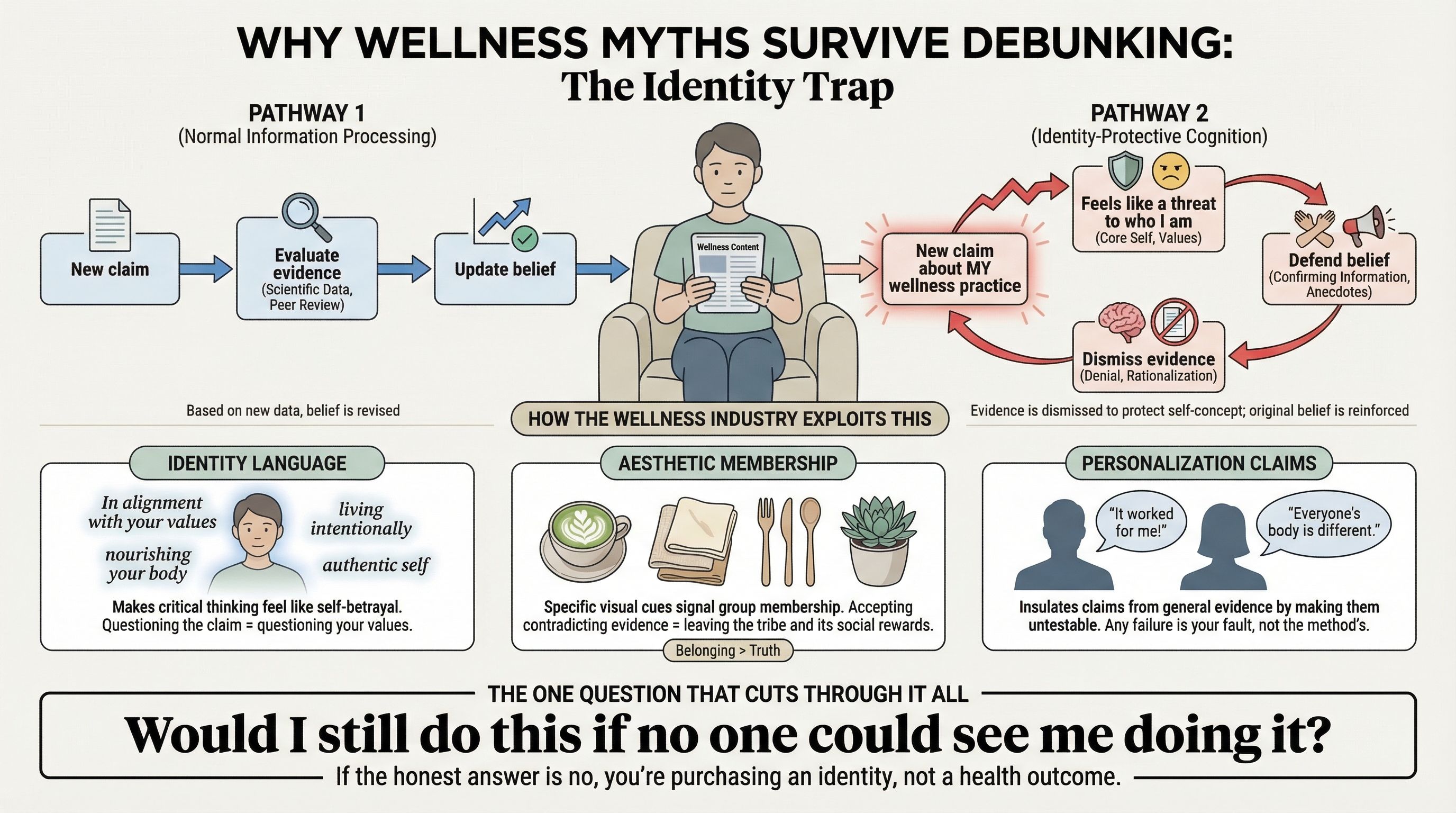
The reason debunking these myths doesn't make them go away is not that people lack information. It's psychology.
Wellness practices increasingly function as identity markers. The morning routine, the supplement stack, the diet framework, the carefully curated food aesthetic on Instagram all become part of how someone defines themselves. And once a health behavior becomes part of your identity, accepting evidence against it stops being an intellectual exercise. It becomes a threat to who you are.
Psychologists call this identity-protective cognition: people process information in ways that protect their self-concept rather than optimize their beliefs. This is why the same person who is highly skeptical of pharmaceutical advertising will completely bypass skepticism for a wellness product with the right aesthetic and the right influencer behind it. The packaging signals membership in a group they identify with.
The wellness industry is extraordinarily good at exploiting this. The language of "alignment," "nourishing your body," and "listening to yourself" is not just friendly, it's strategically designed to make critical evaluation feel like an act of self-betrayal rather than a rational response to evidence.
The most useful question is not "does this wellness practice work?" It's: "Would I still do this if no one could see me doing it?" If the honest answer is no, you're probably buying an identity rather than a health outcome.
Takeaways
Detox products exploit a fundamental misunderstanding of physiology: your liver and kidneys already detoxify your blood continuously through phase I and phase II hepatic processing and 36-daily filtrations, respectively, and no juice cleanse or detox tea has been demonstrated to enhance this in a healthy person, while detox teas frequently contain senna (a stimulant laxative) that produces temporary weight loss from water and gut content rather than fat or toxin elimination, with prolonged use risking electrolyte imbalances and colitis.
Alkaline water cannot alter blood pH because respiratory and renal buffering systems maintain blood at exactly 7.35 to 7.45 regardless of dietary input, and stomach acid at pH 1.5 to 3.5 neutralizes any alkalinity instantly, while oral collagen is the more scientifically legitimate exception: 26 RCTs across 1,721 patients confirm that specifically hydrolyzed collagen peptides (3 to 6 kDa molecular weight, 2.5 to 10g daily for 8 to 12 weeks) significantly improve skin hydration and elasticity, but most commercial collagen gummies and powders do not specify the hydrolysis degree that makes these results possible.
The reason wellness myths survive debunking is identity-protective cognition: when health practices become identity markers, accepting contradicting evidence feels like a self-concept threat rather than a rational update, and the wellness industry deliberately uses language of alignment, nourishment, and self-listening to make critical evaluation feel like self-betrayal, making the most useful filter not "does this work?" but "would I still do this if no one could see me?"
The LED Device Clinics Actually Use.
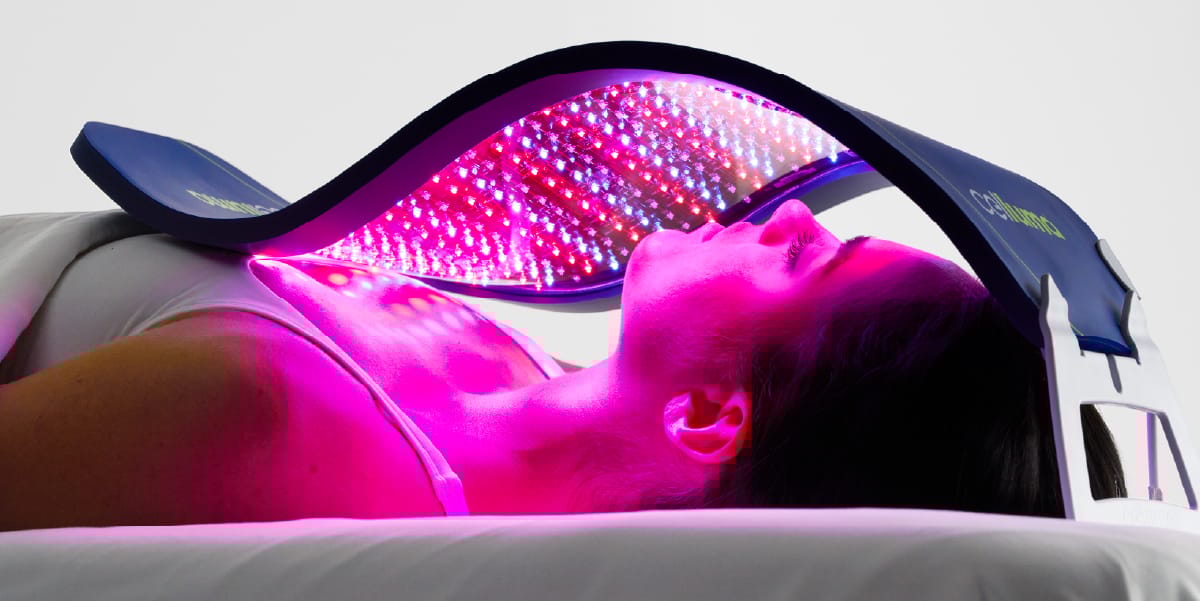
Not all light therapy is created equal.
Celluma is FDA-cleared for wrinkles, acne, pain relief, hair growth, and body contouring — and trusted by physicians worldwide. Professional-grade wavelengths. Patented flexible design. Clinically validated results. If you want the serious version of LED therapy, this is it.
Results vary. Consistent use required.
Feedback & Sponsorship
What'd you think of this week's newsletter? Hit reply to let us know. Did we crush it? Blow your mind? We read every response.
Want your brand in front of hundreds of thousands of readers? Contact us for sponsorship opportunities [email protected]
Want more where that came from? Head to our website
Reply