- Aeviva
- Posts
- Hyperbaric Oxygen Therapy: The Longevity Hack Celebrities Swear By (Does It Actually Work?)
Hyperbaric Oxygen Therapy: The Longevity Hack Celebrities Swear By (Does It Actually Work?)
Athletes, billionaires, and biohackers claim hyperbaric chambers reverse aging, heal injuries faster, and boost performance. Here's what the science actually says
In partnership with

Estimated Read Time: 6 minutes
Before you read this, have you heard the term “longevity”? |
Today's Issue
Main Topic: How hyperbaric oxygen therapy works, the actual evidence for longevity and health benefits, optimal protocols, costs, and whether it's worth the investment
Subtitles:
How HBOT works: oxygen, pressure, and cellular mechanisms
The longevity evidence: telomeres, senescent cells, and mitochondrial function
Proven medical uses: wound healing, brain injuries, and recovery
Protocols, costs, and who should (and shouldn't) use HBOT
Alternatives: cheaper ways to improve oxygen delivery and cellular health
Abstract: Hyperbaric oxygen therapy (HBOT) involves breathing 100% oxygen at atmospheric pressures 1.5-3.0 ATA (atmospheres absolute, compared to normal 1.0 ATA at sea level) inside sealed chamber, increasing dissolved oxygen in blood plasma by 10-15x normal levels (oxygen normally carried primarily by hemoglobin in red blood cells, but under pressure significant oxygen dissolves directly in plasma reaching tissues with poor blood flow). Mechanisms include hyperoxia (super-saturated tissues with oxygen supporting cellular metabolism and healing), increased oxygen diffusion distance (oxygen reaches 3-4x farther from capillaries into damaged or poorly perfused tissues), reduced inflammation (oxygen modulates inflammatory pathways and reduces swelling), enhanced stem cell mobilization (8x increase in circulating stem cells promoting tissue repair), angiogenesis stimulation (growth of new blood vessels improving long-term perfusion), antimicrobial effects (high oxygen toxic to anaerobic bacteria), and mitochondrial biogenesis (creation of new cellular energy factories). Longevity-specific research includes Israeli study (2020, 35 healthy adults over 64) showing 60 daily HBOT sessions (90 minutes, 100% oxygen at 2.0 ATA) increased telomere length 20-38% (protective chromosome caps normally shortening with age) and reduced senescent cell populations 11-37% (damaged "zombie" cells secreting inflammatory molecules driving aging), though study small and results require replication. Proven medical applications with strong evidence include diabetic wound healing (non-healing ulcers, 40-50% improved healing rates), radiation tissue damage (cancer treatment side effects), carbon monoxide poisoning, decompression sickness (the bends in divers), and traumatic brain injury recovery (emerging evidence showing improved cognitive function and reduced inflammation).
Hyperbaric oxygen therapy emerged from diving medicine (treating decompression sickness in 1960s) and wound care (diabetic ulcers, radiation damage), but recent research suggesting anti-aging effects transformed HBOT into buzzy longevity intervention among wealthy biohackers and professional athletes. The premise: aging partially results from declining oxygen delivery to tissues due to vascular dysfunction, reduced capillary density, and mitochondrial decline, creating hypoxic (oxygen-deprived) cellular environments where damaged cells accumulate, inflammation persists, and repair processes stall. Flooding body with oxygen under pressure theoretically overcomes these limitations, reaching poorly perfused tissues, energizing mitochondria, clearing senescent cells, and stimulating repair. A landmark 2020 Israeli study showing 20-38% telomere lengthening and 11-37% senescent cell reduction in healthy elderly adults after 60 HBOT sessions created mainstream excitement, featured in longevity podcasts and biohacking forums. However, critical analysis reveals limitations: small sample size (35 participants), no long-term follow-up confirming sustained benefits, expensive and time-intensive protocol (60 ninety-minute sessions over 3 months), and no data proving increased healthspan or lifespan in humans. This newsletter examines HBOT mechanisms, separates proven medical benefits from speculative anti-aging claims, evaluates cost-benefit ratio, and identifies who might genuinely benefit versus who is wasting money on hype.
Support Your New Years Resolutions with CBD

Setting a New Years resolution is a lot easier than keeping it. But CBDistillery’s expertly-formulated CBD products make sticking with your resolutions easier. Save 25% on CBD to ease pain after workouts, stress less, sleep better or unwind alcohol-free with code HNY25 and keep your resolutions on track.
1. How HBOT Works: Oxygen, Pressure, and Cellular Mechanisms 💨⚡
Normal oxygen delivery: At sea level (1.0 ATA pressure), you breathe 21% oxygen. Hemoglobin in red blood cells carries oxygen to tissues, releasing it where needed. Plasma (liquid part of blood) carries minimal dissolved oxygen. Problem: tissues with poor blood flow (damaged areas, scar tissue, aging tissues with reduced capillaries) receive inadequate oxygen.

Hyperbaric Chamber
Under pressure: HBOT uses 100% oxygen at 1.5-3.0 ATA pressure. This increases dissolved oxygen in plasma by 10-15x. Result: oxygen reaches tissues independent of blood flow, penetrating 3-4x farther from capillaries than normal. Even areas with compromised circulation get oxygen.
Key mechanisms:
Hyperoxia (oxygen supersaturation): Cells bathed in excess oxygen improve energy production, accelerate healing, and support metabolic processes normally limited by oxygen availability.
Reduced inflammation: High oxygen pressures reduce swelling and modulate inflammatory signaling pathways, decreasing chronic inflammation (major aging driver).
Stem cell mobilization: HBOT increases circulating stem cells by 8x, promoting tissue repair and regeneration. Stem cells migrate to damaged areas, differentiating into needed cell types.
New blood vessel growth: Repeated HBOT sessions stimulate angiogenesis (formation of new capillaries), improving long-term tissue oxygenation even after treatment ends.
Mitochondrial support: Extra oxygen enhances mitochondrial function (cellular energy production) and may stimulate creation of new mitochondria, countering age-related mitochondrial decline.

2. The Longevity Evidence: Telomeres, Senescent Cells, and Mitochondrial Function 🧬⏳
The headline study: 2020 Israeli research (published in Aging journal) studied 35 healthy adults over 64 receiving 60 HBOT sessions over 3 months (90 minutes daily, 5 days weekly, 100% oxygen at 2.0 ATA). Results: telomere length increased 20-38% in different immune cell types, senescent cell populations decreased 11-37%.
Why this matters: Telomeres (protective chromosome caps) shorten with each cell division, serving as biological aging clock. When critically short, cells become senescent (stop dividing, release inflammatory molecules) or die. Lengthening telomeres and clearing senescent cells theoretically reverses aspects of biological aging.
The caveats: Small study (35 people), short follow-up (no data on whether benefits persist beyond 3 months), no comparison to other interventions (exercise, fasting, supplements), extremely intensive protocol (60 sessions = $6,000-24,000 depending on location), and most importantly, no evidence this translates to extended healthspan or lifespan. Telomere lengthening could also be risky if it occurs in pre-cancerous cells.
Other longevity-adjacent benefits: Studies show HBOT improves mitochondrial function, reduces systemic inflammation markers, enhances cognitive function in elderly, and improves vascular function. However, these studies measure biomarkers, not actual longevity outcomes.
Bottom line: Intriguing preliminary evidence but far from proven longevity intervention. More research needed with larger samples, longer follow-up, and comparison to simpler interventions.

3. Proven Medical Uses: Wound Healing, Brain Injuries, and Recovery 🏥💪
Strong evidence exists for specific medical conditions:
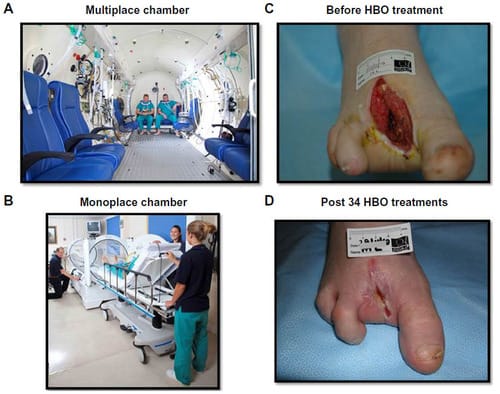
Diabetic foot ulcers: Non-healing wounds in diabetics with poor circulation. HBOT increases oxygen to damaged tissue, promoting healing. Studies show 40-50% improvement in healing rates, reduced amputation risk. FDA-approved, insurance-covered.
Radiation tissue damage: Cancer radiation causes long-term tissue injury (jaw necrosis after head/neck radiation, bladder damage, bone damage). HBOT stimulates healing and new blood vessel growth. Multiple studies confirm benefits.
Carbon monoxide poisoning: CO binds hemoglobin 200x stronger than oxygen, suffocating cells. HBOT displaces CO, rapidly restoring oxygen delivery, preventing brain damage.
Traumatic brain injury (TBI): Emerging evidence shows HBOT improves cognitive function, reduces inflammation, and promotes neuroplasticity in TBI patients (military veterans, athletes with concussions). Several studies show meaningful improvements in memory, processing speed, and symptom reduction.
Athletic recovery: Many professional athletes use mild HBOT (1.3-1.5 ATA) post-workout or post-injury. Evidence is mixed but suggests faster recovery from muscle damage, reduced inflammation, and quicker return to training. Not life-changing but marginal gains matter in elite competition.
Conditions with weak/no evidence: Autism, Lyme disease, fibromyalgia, aging reversal (beyond single small study). Avoid clinics making exaggerated claims about these conditions.
4. Protocols, Costs, and Who Should (and Shouldn't) Use HBOT 💰⚙️
Protocols vary by goal:
Mild HBOT (1.3-1.5 ATA): Soft portable chambers (fabric, zippered). Used by athletes for recovery. Sessions 60-90 minutes. Less effective than medical-grade but more accessible.
Standard medical (2.0-2.4 ATA): Hard chambers (acrylic or steel). FDA-approved conditions. Sessions 60-120 minutes. Most research uses this range.
Intensive (2.5-3.0 ATA): Severe conditions (gas gangrene, decompression sickness). Requires medical supervision.
Typical longevity protocol (based on Israeli study): 60-90 minutes at 2.0 ATA, 5 days weekly for 8-12 weeks (40-60 total sessions).
Costs:
Clinical sessions: $100-400 per session (varies by location, indication). Package of 40 sessions: $4,000-16,000. Insurance covers FDA-approved conditions only (diabetic wounds, radiation damage, etc.), not anti-aging or athletic recovery.
Home chambers: Soft portable chambers $4,000-15,000 one-time purchase. Hard chambers (medical-grade) $20,000-100,000+. If using regularly long-term, home chamber cost-effective versus clinical sessions.
Who should consider:
Medical conditions with proven benefit (diabetic wounds, TBI, radiation damage), professional athletes seeking marginal recovery gains (can afford cost), wealthy biohackers experimenting with longevity interventions (understanding evidence is preliminary), people with access to affordable sessions or who can purchase home chamber.
Who should skip:
Limited budget (other interventions provide better value), expecting miracle anti-aging cure (evidence too preliminary), anyone with contraindications (see below).
Contraindications and side effects:
Ear barotrauma (most common, like scuba diving, difficulty equalizing pressure causes pain, can rupture eardrum), temporary vision changes (myopia from oxygen affecting lens proteins, reversible), claustrophobia (enclosed chamber anxiety), oxygen toxicity (rare, seizures at very high pressures), untreated pneumothorax (collapsed lung, absolute contraindication), certain medications (bleomycin, doxorubicin increase oxygen toxicity risk), pregnancy.
5. Alternatives: Cheaper Ways to Improve Oxygen Delivery and Cellular Health 🏃♂️💊

Before spending thousands on HBOT, consider these evidence-based alternatives:
Exercise (especially HIIT): High-intensity interval training stimulates angiogenesis (new blood vessel growth), increases mitochondrial density, improves oxygen delivery, and extends telomeres. Studies show regular exercisers have telomeres equivalent to 9 years younger. Cost: free.
Intermittent hypoxia training: Breathing low-oxygen air intermittently (altitude training masks, specialized devices) triggers similar adaptations to HBOT through opposite mechanism (controlled oxygen restriction). Improves mitochondrial efficiency and vascular function. Cost: $100-500 for device versus $10,000+ for HBOT.
Breathwork: Wim Hof method, box breathing, and other techniques improve oxygen utilization, reduce inflammation, and enhance cellular energy. Free, evidence-based, no equipment needed.
NAD+ precursors (NMN/NR): Boost cellular energy production and mitochondrial function through different pathway than oxygen. Cost: $40-80 monthly versus $4,000-16,000 for HBOT course.
Cardiovascular health optimization: Managing blood pressure, cholesterol, blood sugar, and maintaining healthy weight improves tissue oxygenation more sustainably than periodic HBOT. Address root causes of poor perfusion.
Cold exposure: Cold plunges, cold showers stimulate mitochondrial biogenesis, reduce inflammation, and improve circulation. Cost: minimal.
Adequate sleep: Poor sleep reduces growth hormone (needed for tissue repair), increases inflammation, and impairs cellular cleanup (autophagy). Optimizing sleep provides many benefits attributed to HBOT. Cost: free.
💡 Pro Tip: If considering HBOT for longevity, first optimize free interventions (exercise, sleep, diet, stress management). If you have specific medical condition with proven HBOT benefit (diabetic wound, TBI, radiation damage), insurance may cover it. For anti-aging, wait for more research before investing thousands.
One Simple Scoop For Better Health

The best healthy habits aren't complicated. AG1 Next Gen helps support gut health and fill common nutrient gaps with one daily scoop. It's one easy routine that fits into real life and keeps your health on track all day long. Start your mornings with AG1 and keep momentum on your side.
Takeaways
Hyperbaric oxygen therapy (breathing 100% oxygen at 1.5-3.0 ATA pressure in sealed chamber) increases dissolved oxygen in blood 10-15x normal levels, reaching tissues 3-4x farther from capillaries and triggering cellular mechanisms including reduced inflammation, 8x stem cell mobilization, new blood vessel growth, and enhanced mitochondrial function, with small 2020 study showing 20-38% telomere lengthening and 11-37% senescent cell reduction after 60 sessions though evidence too preliminary to confirm anti-aging benefits.
Proven medical applications with strong evidence include diabetic wound healing (40-50% improved healing rates), radiation tissue damage recovery, traumatic brain injury (cognitive improvements in emerging research), carbon monoxide poisoning, and athletic recovery (faster muscle repair, reduced inflammation), while conditions like autism, Lyme disease, and general anti-aging lack sufficient supporting evidence.
Protocols require 40-60 sessions at 2.0 ATA (60-90 minutes each) costing $100-400 per clinical session ($4,000-16,000 total) or $4,000-15,000 for home portable chamber, with free alternatives like exercise (stimulates angiogenesis, increases mitochondrial density, extends telomeres equivalent to 9 years younger), intermittent hypoxia training, breathwork, sleep optimization, and cardiovascular health management providing similar benefits at fraction of cost.
Feedback & Sponsorship
What'd you think of this week's newsletter? Hit reply to let us know. Did we crush it? Blow your mind? We read every response.
Want your brand in front of hundreds of thousands of readers? Contact us for sponsorship opportunities [email protected]
Want more where that came from? Head to our website
Reply