- Aeviva
- Posts
- 15-Minute HIIT Workout at Home That Burns More Calories Than a 60-Minute Run
15-Minute HIIT Workout at Home That Burns More Calories Than a 60-Minute Run
High-Intensity Interval Training torches 25-30% more calories than steady cardio in a fraction of the time - here's the science and exact workout
In partnership with

Estimated Read Time: 5 minutes
Running for an hour burns about 600 calories.
A 15-minute HIIT workout burns 200-300 calories during the session - then continues burning 100-200 MORE calories for 24 hours after you stop (the "afterburn effect").
You get better results in 1/4 of the time, with zero equipment needed.
Today's Issue
Main Topic: Why HIIT burns more calories than running and the exact 15-minute at-home workout that matches a 60-minute run
Subtitles:
Why HIIT burns more calories than steady cardio: EPOC and the afterburn effect
The 15-minute workout: exercises, timing, and how to do it
Abstract: High-Intensity Interval Training (HIIT) burns 25-30% more calories than steady-state cardio (running, cycling) through EPOC (excess post-exercise oxygen consumption, the "afterburn effect") where metabolism remains elevated 15-48 hours post-workout consuming additional 100-200 calories beyond the workout itself, compared to steady cardio where calorie burn stops immediately upon finishing. A 15-minute HIIT session burns 200-300 calories during exercise plus 100-200 calories from EPOC (total 300-500 calories), matching or exceeding a 60-minute run (500-600 calories) while requiring significantly less time and no equipment. The workout structure uses 40 seconds work, 20 seconds rest intervals (proven optimal in studies) across 5 exercises repeated 3 rounds: burpees (full-body explosive movement engaging all major muscle groups), mountain climbers (cardio + core), jump squats (lower body power + cardiovascular demand), high knees (cardiovascular intensity), and push-ups (upper body strength + core stability). HIIT's superior calorie burn derives from high-intensity efforts (80-95% max heart rate) creating oxygen debt requiring extended recovery, increased muscle protein synthesis demanding energy for repair, and metabolic adaptation improving insulin sensitivity and fat oxidation for 24+ hours post-exercise.
The traditional approach to burning calories through exercise emphasizes duration over intensity - the cultural image of weight loss involves logging miles on treadmills, clocking 60+ minute runs, or spending hours in "fat-burning zones" on cardio equipment. However, exercise science over the past two decades has consistently demonstrated that high-intensity interval training (HIIT) - characterized by short bursts of maximum effort alternating with brief recovery periods - produces superior calorie expenditure and metabolic benefits in dramatically less time than steady-state cardio. Understanding why requires examining EPOC (excess post-exercise oxygen consumption), the physiological phenomenon where your body continues burning calories at elevated rates for 15-48 hours after intense exercise as it repairs muscle tissue, replenishes energy stores, and returns systems to baseline. A moderate 60-minute run at conversational pace burns approximately 500-600 calories for a 150-pound person during the activity itself, with minimal afterburn - your metabolism returns to normal within 1-2 hours. In contrast, a properly structured 15-minute HIIT workout burns 200-300 calories during the session while triggering significant EPOC that consumes an additional 100-200 calories over the following 24 hours, creating total calorie expenditure of 300-500 calories in 1/4 of the time investment with zero equipment required. This newsletter explains the metabolic mechanisms making HIIT more efficient than traditional cardio and provides a precise 15-minute at-home workout designed to maximize calorie burn through strategic exercise selection, work-to-rest ratios, and intensity targets.
Finally serious about losing weight?

Ready to lose weight with a plan that actually works? MedVi provides highly effective GLP-1 treatments, personalized guidance, and everything you need to see real, consistent fat-loss results.
There are no membership fees, nothing confusing, and no insurance required. Just one simple, science-backed program that helps you get healthier each week.
Start today for only $179 and get free shipping.
Read all warnings before using GLP-ls. Side-effects may include a risk of thyroid c-cell tumors. Do not use GLP-1s if you or your family have a history of thyroid cancer. In certain situations, where clinically appropriate, a provider may prescribe compounded medication, which is prepared by a state-licensed sterile compounding pharmacy partner. Although compounded drugs are permitted to be prescribed under federal law, they are not FDA-approved and do not undergo FDA review for safety, effectiveness, or manufacturing quality.
1. Why HIIT Burns More Calories Than Steady Cardio: EPOC and the Afterburn Effect 🔥📊
The calorie math:
60-minute run at moderate pace (6-7 mph):
During exercise: 500-600 calories burned
After exercise (EPOC): 20-40 calories over 1-2 hours
Total: 520-640 calories
Time investment: 60 minutes
15-minute HIIT workout at maximum effort:
During exercise: 200-300 calories burned
After exercise (EPOC): 100-200 calories over 24-48 hours
Total: 300-500 calories
Time investment: 15 minutes
The science behind EPOC (Excess Post-Exercise Oxygen Consumption):
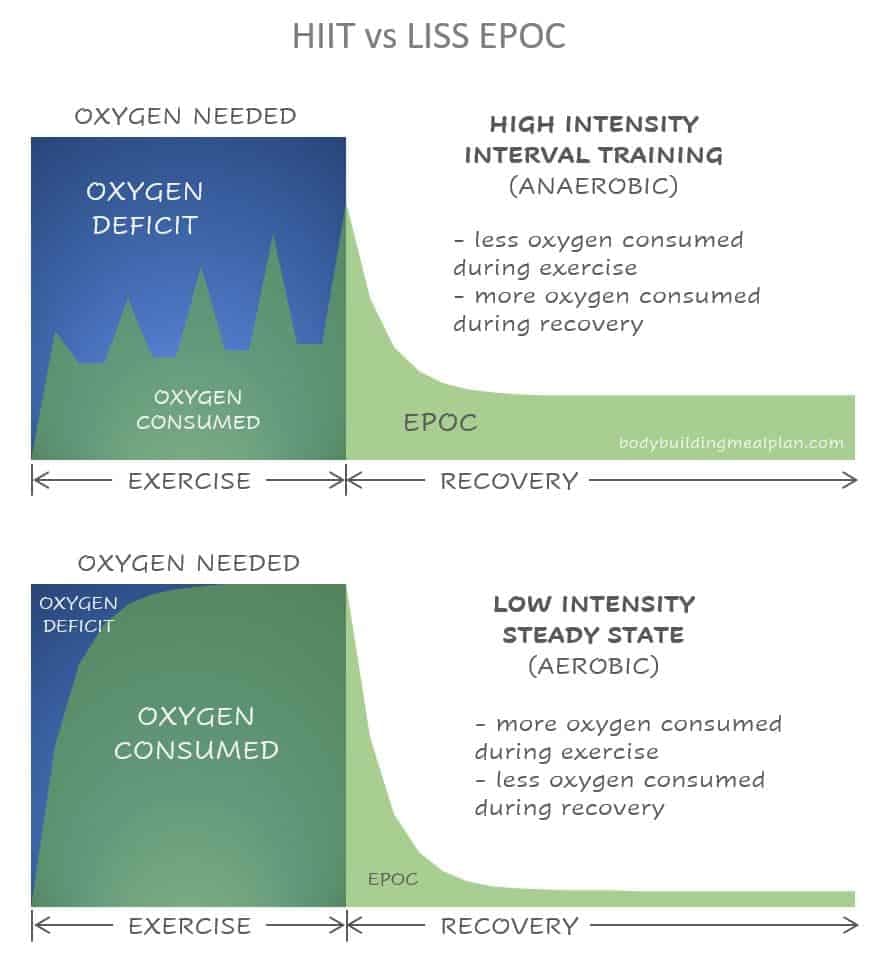
When you exercise at high intensity (80-95% max heart rate), your body creates an "oxygen debt" - you're working so hard that muscles can't get enough oxygen to produce energy aerobically, forcing them to use anaerobic metabolism (burning fuel without oxygen). This creates metabolic byproducts (lactate, hydrogen ions) that must be cleared, damaged muscle fibers that need repair, and depleted energy stores requiring replenishment.
After you stop exercising, your body works overtime to:
Clear lactate from muscles and blood
Repair micro-tears in muscle tissue (protein synthesis)
Replenish ATP and creatine phosphate (energy molecules)
Restore oxygen levels in blood and muscles
Lower elevated body temperature
Return heart rate and breathing to normal
All these processes require energy (calories), keeping your metabolism elevated for hours after the workout ends. This is EPOC - the "afterburn effect."
Why steady cardio doesn't create EPOC:
When you run at a comfortable pace for 60 minutes, you're working aerobically (with sufficient oxygen). Your body efficiently produces energy without creating significant metabolic disruption. The moment you stop running, your breathing and heart rate quickly return to normal (within minutes), and calorie burn drops immediately back to baseline.
Additional HIIT benefits beyond calorie burn:
Preserves muscle mass: Steady cardio (especially long duration) can break down muscle for fuel. HIIT stimulates muscle growth through explosive movements, preserving or building lean mass.
Time efficiency: 15 minutes vs 60 minutes means higher adherence. People actually DO 15-minute workouts consistently, while "I don't have time for an hour run" becomes excuse.
Metabolic adaptation: Regular HIIT improves insulin sensitivity, increases mitochondria (cellular energy factories), and enhances fat oxidation - your body gets better at burning fat for fuel even at rest.
Cardiovascular benefits: HIIT improves VO2 max (aerobic capacity) more than steady cardio. Studies show 8 weeks of HIIT improves cardiovascular fitness 2x more than traditional cardio.
💡 Critical Context: HIIT only works if you actually go HARD during work intervals. If you're doing "high-intensity" intervals while scrolling your phone or chatting, you're not creating the metabolic disruption needed for EPOC. Maximum effort = can't talk, breathing heavily, muscles burning.
2. The 15-Minute Workout: Exercises, Timing, and How to Do It 💪⏱️
Workout structure:
Format: 40 seconds work, 20 seconds rest (Tabata-style intervals proven optimal for EPOC)
Rounds: 3 total rounds of 5 exercises = 15 minutes
Equipment needed: None (bodyweight only)
Intensity target: 8-9 out of 10 effort during work intervals (you should be breathing hard, unable to talk)
The 5 exercises (performed in order, repeated 3 rounds):
Exercise 1: Burpees (40 seconds work, 20 seconds rest)
Full-body explosive movement engaging legs, core, chest, arms, and cardiovascular system.
How to do it: Start standing. Drop hands to floor, jump feet back to plank position, perform push-up (chest touches ground), jump feet back to hands, explosively jump up with arms overhead. Repeat continuously for 40 seconds. Go as fast as possible while maintaining form.
Beginner modification: Step feet back instead of jumping, eliminate push-up, step feet forward, reach arms overhead without jumping.
Exercise 2: Mountain Climbers (40 seconds work, 20 seconds rest)
Cardio + core engagement, maintains elevated heart rate.
How to do it: Start in plank position (hands under shoulders, body straight). Drive right knee toward chest, quickly switch and drive left knee toward chest while extending right leg back. Continue alternating knees as fast as possible - like "running" in plank position. Keep hips level, core tight.
Beginner modification: Slow the pace, focus on control over speed.
Exercise 3: Jump Squats (40 seconds work, 20 seconds rest)
Lower body power + cardiovascular demand, maximizes leg muscle recruitment.
How to do it: Stand with feet shoulder-width apart. Lower into squat (hips back, thighs parallel to ground). Explosively jump as high as possible, extending arms overhead. Land softly with bent knees, immediately drop into next squat. Repeat for 40 seconds.
Beginner modification: Regular bodyweight squats (no jump), or half-height jumps.
Exercise 4: High Knees (40 seconds work, 20 seconds rest)
Pure cardiovascular intensity, active recovery for upper body while maintaining heart rate.
How to do it: Run in place, driving knees up to hip height (or higher). Pump arms vigorously. Go as fast as possible - aim for 100+ knee drives in 40 seconds. Stay on balls of feet.
Beginner modification: March in place with exaggerated knee lifts, slower pace.
Exercise 5: Push-Ups (40 seconds work, 20 seconds rest)
Upper body strength + core stability, brief intensity reduction before repeating round.
How to do it: Start in plank position. Lower chest to ground (elbows at 45-degree angle), push back up. Perform as many quality reps as possible in 40 seconds. Maintain straight body - no sagging hips.
Beginner modification: Knee push-ups (knees on ground), or hands elevated on chair/couch.
Complete workout flow:
Round 1: Burpees (40s) → Rest (20s) → Mountain Climbers (40s) → Rest (20s) → Jump Squats (40s) → Rest (20s) → High Knees (40s) → Rest (20s) → Push-Ups (40s) → Rest (20s)
Rest 1 minute (water break)
Round 2: [Repeat all 5 exercises]
Rest 1 minute
Round 3: [Repeat all 5 exercises]
Total time: 15 minutes (includes rest periods)
Tips for maximizing results:
Warm up (3-5 minutes): Light jogging in place, arm circles, leg swings, jumping jacks. Don't skip - prevents injury and improves performance.
Go HARD during work intervals: The whole point is maximum effort. If you finish 40 seconds and could have kept going easily, you didn't go hard enough.
Use rest periods: 20 seconds is for catching breath, shaking out muscles. Don't cut it short trying to be tough.
Track progress: Count reps for each exercise. Next time, try to beat your numbers.
Frequency: 3-4x per week maximum. HIIT is intense - you need recovery days. Combine with 2-3 days of moderate activity (walking, yoga) and 1-2 rest days.
Cool down (3-5 minutes): Walk slowly, stretch major muscle groups. Helps reduce soreness.

💡 Pro Tip: Set a timer app (Tabata Timer, Interval Timer apps) that beeps for work/rest intervals so you don't have to watch a clock. This lets you focus 100% on effort.
Feel Better Today

If you feel stressed, anxious or depressed, you do not have to suffer alone. With BetterHelp, you can connect with a therapist who fits your needs and schedule. No commute, no waiting rooms - just real, meaningful help. Get started today - therapy has never been easier. Take 25% off your first month without HSA & FSA eligible service.
This email was delivered by a third-party, on behalf of BetterHelp. Copyright © 2025 BetterHelp. All Rights Reserved. 990 Villa St, Mountain View, California, United States.
Takeaways
HIIT burns 25-30% more total calories than steady cardio through EPOC (excess post-exercise oxygen consumption), where metabolism remains elevated 15-48 hours post-workout burning an additional 100-200 calories beyond the exercise itself, creating total calorie expenditure of 300-500 calories from a 15-minute session matching a 60-minute run's 500-600 calories in 1/4 the time.
The 15-minute workout uses 40 seconds work, 20 seconds rest intervals across 5 exercises (burpees, mountain climbers, jump squats, high knees, push-ups) repeated 3 rounds, requiring maximum effort (80-95% max heart rate, unable to talk) during work intervals to create metabolic disruption triggering EPOC and afterburn effect.
HIIT provides superior benefits beyond calorie burn including preserved muscle mass (versus steady cardio's muscle breakdown), improved insulin sensitivity, increased mitochondrial density, enhanced fat oxidation, and 2x greater cardiovascular fitness improvements, with studies showing 28% greater fat loss despite 40% less exercise time compared to moderate-intensity continuous training.
Feedback & Sponsorship
What'd you think of this week's newsletter? Hit reply to let us know. Did we crush it? Blow your mind? We read every response.
Want your brand in front of hundreds of thousands of readers? Contact us for sponsorship opportunities [email protected]
Want more where that came from? Head to our website
Consider this our entire pitch:

Morning Brew isn’t your typical business newsletter — mostly because we actually want you to enjoy reading it.
Each morning, we break down the biggest stories in business, tech, and finance with wit, clarity, and just enough personality to make you forget you’re reading the news. Plus, our crosswords and quizzes are a dangerously fun bonus — a little brain boost to go with your morning coffee.
Join over 4 million readers who think staying informed doesn’t have to feel like work.
Reply