- Aeviva
- Posts
- Forget Cloud Storage: DNA Can Hold Zettabytes of Data in a Drop of Water
Forget Cloud Storage: DNA Can Hold Zettabytes of Data in a Drop of Water
Scientists are encoding movies, books, and databases into synthetic DNA - storing petabytes in molecules smaller than a grain of salt
In partnership with

Estimated Read Time: 6 minutes
Every two days, humanity creates more data than all of civilization produced before 2003.
We're building massive data centers consuming entire power grids to store cat videos and vacation photos.
Meanwhile, scientists can encode 215 petabytes (215 million gigabytes) of data into a single gram of DNA - and it lasts for thousands of years without electricity.
Today's Issue
Main Topic: How DNA storage works, why it's the future of data, and when you'll be able to buy a DNA hard drive
Subtitles:
The data storage crisis: why we're running out of room
What DNA storage is and how it works at the molecular level
Encoding digital data into genetic sequences (A, T, G, C)
Reading data back: sequencing DNA to retrieve files
Current achievements: movies, operating systems, and Wikipedia stored in DNA
The advantages: density, durability, and energy efficiency vs traditional storage
The challenges: cost, speed, and error rates
When DNA storage becomes commercial reality
Abstract: DNA data storage encodes digital information (binary 0s and 1s) into nucleotide sequences (adenine A, thymine T, guanine G, cytosine C) using mapping schemes like A=00, T=01, G=10, C=11, synthesizing custom DNA strands containing encoded data, and retrieving information through DNA sequencing that reads nucleotide order and converts back to binary. Storage density reaches 215-455 petabytes per gram of DNA (1 gram storing entire internet's text content) compared to hard drives achieving 0.001 petabytes per gram, with DNA remaining stable for 500-2,000+ years at room temperature versus magnetic/optical storage degrading within 5-30 years requiring constant energy for cooling and maintenance. Current demonstrations include encoding 2.6 megabyte GIF animation (Harvard, 2017), entire computer operating system with files (Microsoft/University of Washington, 2019), complete Wikipedia snapshot (researchers storing 16GB, 2021), and Netflix show episode (Twist Bioscience, 2021) with retrieval accuracy 99.99%+ using error-correction codes adapted from telecommunications. Major obstacles include synthesis cost ($1,000-3,500 per megabyte in 2024, needs $100 per megabyte for commercial viability), write speed (synthesizing megabyte takes hours-days versus seconds for hard drives), read speed (sequencing slower than electronic retrieval), and error rates (5-10% during synthesis requiring redundancy).
Humanity's data storage problem is accelerating toward crisis as global data creation grows exponentially (64.2 zettabytes generated in 2020, projected 181 zettabytes by 2025) while conventional storage technologies approach physical and economic limits. Modern data centers consume 1-2% of global electricity just maintaining magnetic hard drives and solid-state drives that degrade within years, requiring constant energy for cooling, regular replacement, and ever-expanding physical infrastructure occupying entire warehouses. Meanwhile, nature solved the information storage problem 3.5 billion years ago when life evolved DNA (deoxyribonucleic acid), a molecular storage medium so efficient that every cell in your body contains 6 billion DNA base pairs (your complete genetic code, about 1.5 gigabytes of information) packed into a nucleus 10 micrometers in diameter. Understanding how scientists are harnessing DNA's storage capacity for digital data requires examining the molecular encoding process (mapping binary computer data to four-letter genetic alphabet A-T-G-C), synthesis techniques creating custom DNA strands containing encoded information, sequencing methods reading DNA to retrieve data with 99.99%+ accuracy, remarkable storage density advantages (one gram of DNA storing what would require thousands of hard drives), extraordinary longevity (DNA recovered from 700,000-year-old horse bones, proving information persistence far exceeding any human technology), current proof-of-concept demonstrations encoding operating systems and movies, remaining technical obstacles around synthesis cost and speed, and realistic timeline for commercial DNA storage systems. This newsletter breaks down the science of molecular data storage, what's already been achieved, why DNA beats every conventional storage technology, and when you might actually use it.

Invest in Renewable Energy Projects Across America
Across America, communities are being powered thanks to investors on Climatize who have committed to a brighter future.
Climatize lists vetted renewable energy investment offerings in different states.
As of November 2025, over $13.2 million has been invested across 28 projects on the platform, and over $3.6 million has already been returned to our growing community of thousands of members. Returns aren’t guaranteed, and past performance does not predict future results.
On Climatize, you can explore vetted clean energy offerings, including past projects like solar farms in Tennessee, grid-scale battery storage units in New York, and EV chargers in California. Each offering is reviewed for transparency and provides a clear view of how clean energy takes shape.
Investors can access clean energy projects from $10 through Climatize. Through Climatize, you can see and hear about the end impact of your money in our POWERED by Climatize stories.
Climatize is an SEC-registered & FINRA member funding portal. Crowdfunding carries risk, including loss.
1. The Data Storage Crisis: Why We're Running Out of Room 💾🌍
The exponential data problem:
Humanity created 64.2 zettabytes of data in 2020. A zettabyte is 1 trillion gigabytes. Projections show 181 zettabytes annually by 2025, doubling every 3-4 years. This includes social media, streaming video, IoT sensors, scientific datasets, medical imaging, surveillance footage, and AI training data.
Storage infrastructure limits:

How Much Energy Do Data Centers Really Use
Physical space: Data centers already occupy millions of square feet globally. Microsoft's Iowa data center spans 1.3 million square feet. Facebook's Utah facility uses 1.5 million square feet. Expanding further requires enormous land and construction.
Energy consumption: Data centers consume 200+ terawatt-hours annually (1-2% of global electricity). Hard drives require constant power for motors and cooling systems. This energy demand grows exponentially with data creation.
Lifespan limits: Hard disk drives last 3-5 years before failure rates spike. SSDs last 5-10 years. Magnetic tape degrades after 10-30 years. All data must be migrated to new storage periodically, creating endless copying cycles.
Economic unsustainability: Building and operating data centers costs billions. Amazon Web Services spent $59 billion on infrastructure in 2022.
Why current approaches won't scale:
Environmental impact (energy consumption, carbon emissions, e-waste), resource limits (rare earth elements becoming scarce), physical constraints (limited suitable locations), and economic problems make current approaches unsustainable.
💡 Critical Context: If data growth continues at current rates without radical storage improvements, we'd need to convert entire countries into data centers by 2050. DNA storage isn't science fiction - it's potentially necessary.
2. What DNA Storage Is and How Encoding Works 🧬💻
DNA structure basics:
DNA is made of nucleotides containing one of four bases:
A (Adenine)
T (Thymine)
G (Guanine)
C (Cytosine)

DNA Structure
These four letters form the genetic alphabet. Human DNA contains about 3 billion base pairs spelling out genetic instructions.
Why DNA works for data storage:
Four-letter alphabet: Computers use binary (0s and 1s). DNA uses quaternary (A, T, G, C). Each DNA base stores 2 bits of information versus 1 bit in binary.
Molecular density: DNA molecules are 2 nanometers wide. Billions fit in a grain of salt, creating unmatched storage density.
Chemical stability: DNA remains intact for thousands of years if kept dry and cool. DNA recovered from 700,000-year-old fossils proves information persists far exceeding any human technology.
The encoding process:
Step 1: Convert file to binary
Any digital file is already binary code (0s and 1s). Text "HELLO" becomes: 01001000 01000101 01001100 01001100 01001111
Step 2: Map binary to DNA bases
Simple encoding scheme:
00 = A
01 = T
10 = G
11 = C
"HELLO" (01001000 01000101...) becomes DNA sequence: TAGA TATT TAGA TAGA TACC...
Step 3: Add error correction
Like telecommunications, DNA storage uses redundancy and error-correction codes. Information is encoded multiple times with parity checks, allowing reconstruction even if some DNA strands have errors.
Step 4: Divide into chunks
Large files split into segments (100-200 bases per strand). Each segment includes indexing information (like page numbers) allowing reassembly.
3. Reading Data Back: Sequencing DNA to Retrieve Files 📖🔬
Writing data (DNA synthesis):
Creating custom DNA strands happens through oligonucleotide synthesis:
Phosphoramidite chemistry: Standard method adds nucleotides one at a time. Each addition takes 3-5 minutes. Synthesizing a 200-base strand takes 10-17 hours.
Enzymatic synthesis: Newer approach uses enzymes to add nucleotides faster, potentially reducing synthesis time to minutes.
Current limits: Commercial synthesis creates strands up to 200-300 bases reliably. For large files, millions of short DNA strands are synthesized and pooled together.
Reading data (DNA sequencing):
Illumina sequencing: DNA strands attached to flow cell, amplified, and fluorescent-labeled nucleotides added sequentially. Cameras detect which base by color (A=green, T=red, G=blue, C=yellow). Can sequence billions of bases per run, taking hours to days.
Nanopore sequencing: DNA passes through protein nanopores. Each base creates distinct electrical signal. Real-time reading without amplification. Faster but higher error rates (5-15% vs 0.1% for Illumina).
Decoding process:
Sequence all DNA strands in pool
Use index information to sort strands into correct order
Convert DNA sequences back to binary (A=00, T=01, G=10, C=11)
Apply error correction to fix sequencing mistakes
Reconstruct original file from binary
Accuracy: With error correction, retrieval accuracy exceeds 99.99%. Lost or damaged strands compensated through redundancy.

4. Current Achievements: Movies, Operating Systems, and Wikipedia Stored in DNA 🎬💿
Harvard University (2017) - First motion picture:
Encoded 2.6 megabyte GIF animation into E. coli bacteria DNA. Retrieved with 90% accuracy. Proved concept works in living cells.
Microsoft and University of Washington (2019) - Operating system:
Encoded entire computer operating system, files, and music video (200 megabytes total) into synthetic DNA. Retrieved and executed successfully. First demonstration of functional software stored and retrieved from DNA.
ETH Zurich (2020) - DNA in glass:
Encoded 5-megabyte Swiss Federal Charter into DNA encapsulated in glass nanospheres. Stored at 65°C for weeks, retrieved perfectly. Proved DNA storage withstands harsh conditions.
Twist Bioscience and Microsoft (2021) - Wikipedia:
Encoded complete English Wikipedia snapshot (16 GB of text) into DNA strands. Successfully retrieved random articles on demand with perfect accuracy.
Catalog Technologies (2021) - Netflix show:
Encoded Netflix "Biohackers" episode (multiple gigabytes) into DNA. Streamed back by sequencing DNA, decoding, and playing video in real-time.
University of Texas (2024) - 100GB at scale:
Encoded and retrieved 100 GB of text files using new algorithms reducing cost and synthesis time by 60%.
What these prove:
Complex files (video, software, databases) can be perfectly stored and retrieved. Technology works at multi-gigabyte scale. Error correction allows near-perfect accuracy. Retrieval can be selective (accessing specific files without sequencing everything).
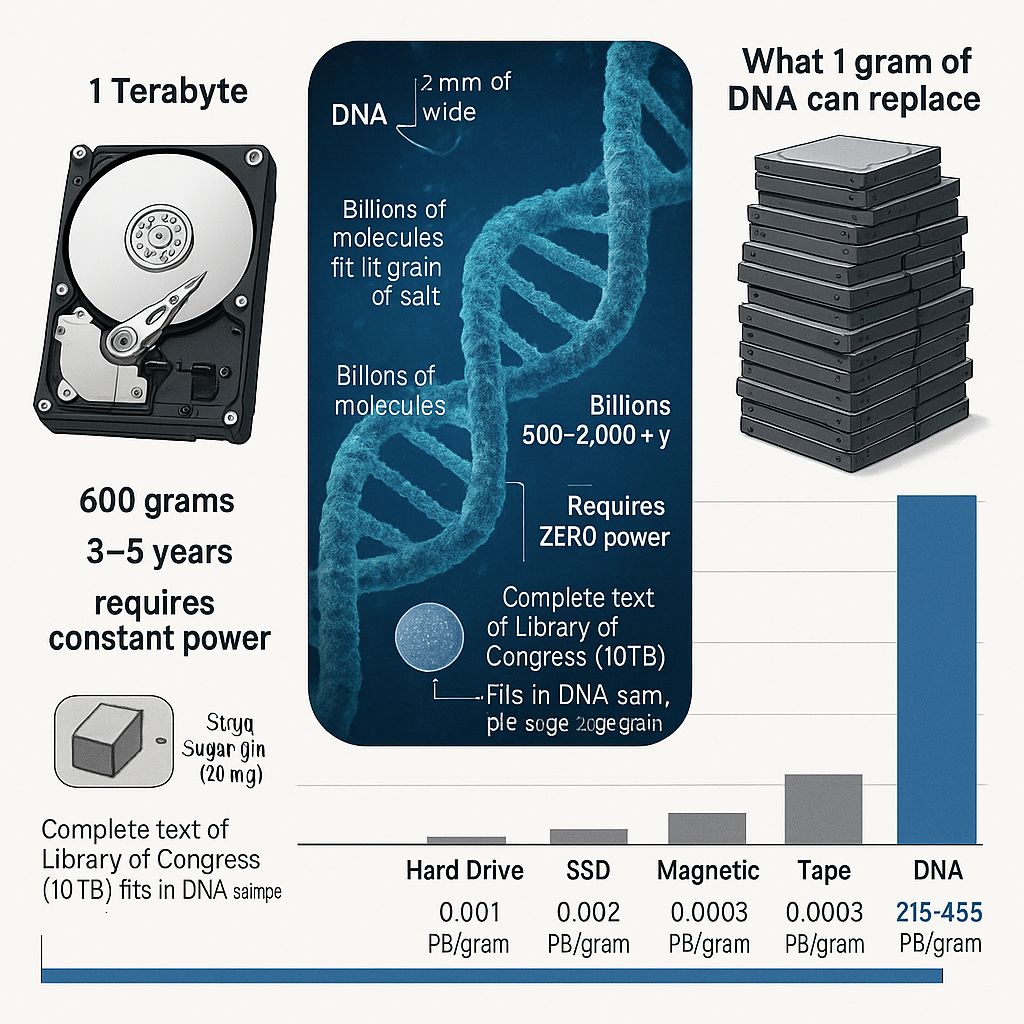
💡 Fun Fact: Complete text of every Library of Congress book (10 TB) could fit in DNA sample the size of a sugar grain, weighing 20 milligrams.
TP5/TP5x are now $44.99

If you know golf, you know the ball matters. TP5 and TP5x are the balls top players switch to when they want tour-level speed, control, and feel. And this holiday season, TaylorMade has dropped the price to just $44.99. Stock up now, for less, and make every round feel a lot more dialed in.
Takeaways
DNA data storage encodes digital files into nucleotide sequences (A, T, G, C) achieving 215-455 petabytes per gram density (100,000x better than hard drives) with 500-2,000+ year stability requiring zero energy once synthesized, using mapping schemes converting binary to quaternary bases, synthesizing custom strands containing encoded data, and retrieving through DNA sequencing with 99.99%+ accuracy using error-correction codes.
Major demonstrations include encoding entire operating systems, 16GB Wikipedia snapshot, Netflix episodes, and functional software successfully retrieved from synthetic DNA (Microsoft, Twist Bioscience, University of Washington 2017-2024), proving technology works at multi-gigabyte scale for complex files though current synthesis costs $1,000-3,500 per megabyte versus commercial viability target $100 per megabyte.
Feedback & Sponsorship
What'd you think of this week's newsletter? Hit reply to let us know. Did we crush it? Blow your mind? We read every response.
Want your brand in front of hundreds of thousands of readers? Contact us for sponsorship opportunities [email protected]
Want more where that came from? Head to our website
Invest in Renewable Energy Projects
People across the U.S. can invest in renewable energy projects through Climatize. More than $13.2M has been invested through the platform so far, with over $3.6M returned to investors to date. Returns not guaranteed.
You can explore American clean energy projects raising capital right now.
Climatize is an SEC-registered & FINRA member funding portal. Crowdfunding carries risk, including loss.
Reply