- Aeviva
- Posts
- Can Everyone Build Muscle?
Can Everyone Build Muscle?
Some people gain 20 pounds of muscle in a year, others struggle to gain 5 - here's why genetics matter more than you think

In partnership with

Estimated Read Time: 6 minutes
Two people follow the same workout program and diet for 12 months.
Person A gains 18 pounds of muscle and looks completely transformed.
Person B gains 3 pounds of muscle and looks almost the same.
Today's Issue
Main Topic: Why some people build muscle easily while others struggle, and what you can actually control
Subtitles:
The genetic factors that determine muscle-building potential
Muscle fiber types: why sprinters look different from marathon runners
Testosterone, myostatin, and other hormones that control muscle growth
Age, sex, and training history: who has the advantage
What you CAN control: training, nutrition, and realistic expectations
Abstract: Muscle-building capacity varies dramatically between individuals due to genetic factors including muscle fiber type distribution (fast-twitch fibers grow 2-3 times larger than slow-twitch), myostatin levels (a protein limiting muscle growth, with naturally low myostatin causing exceptional muscle-building), testosterone levels (men average 15-20 times more than women, directly correlating with muscle growth rate), satellite cell number (muscle stem cells enabling growth and repair), and tendon insertion points (determining leverage and strength potential). Studies show muscle gain from identical training programs ranges from 0 pounds to 12+ pounds over 12 weeks, with average gain of 4-5 pounds but 20% of people classified as "non-responders" gaining minimal muscle and 5% as "extreme responders" gaining triple the average. Age significantly impacts muscle-building, with peak anabolic response in late teens to early 30s, declining 3-8% per decade after 30 due to reduced testosterone, growth hormone, and satellite cell activity, though resistance training remains effective at all ages with proper programming. Women build muscle at approximately 50-70% the rate of men due to lower testosterone but respond to the same training principles. Training variables (progressive overload, volume, frequency, exercise selection), nutrition (protein 1.6-2.2g per kg bodyweight, caloric surplus), and recovery determine whether genetic potential is reached, with realistic expectations being 15-25 pounds muscle gain in first year for men, 8-12 pounds for women, halving each subsequent year.
The fitness industry sells the myth that anyone can look like a bodybuilder or fitness model with enough hard work, the right program, and proper nutrition. This is false. While everyone can build some muscle and significantly improve their physique, genetics place hard limits on muscle-building potential that no amount of training or eating can overcome.
Some people are genetic lottery winners with naturally high testosterone, low myostatin (a protein that limits muscle growth), high proportion of fast-twitch muscle fibers (the type that grows larger), optimal tendon insertion points (providing better leverage), and abundant satellite cells (muscle stem cells enabling growth). These people build muscle easily, gaining 15-25 pounds in their first year of proper training.
Others are genetic non-responders with the opposite profile, struggling to gain 3-5 pounds per year despite perfect training and nutrition. The gap between genetic extremes is enormous, far larger than most people realize. Understanding what's genetically determined versus what's controllable prevents unrealistic expectations and wasted effort chasing unattainable physiques.
This newsletter examines the major genetic factors determining muscle-building capacity (fiber types, hormones, satellite cells, skeletal structure), how age and sex affect muscle growth, what percentage of the population are "easy gainers" versus "hard gainers," and most importantly, what variables you can actually control (training programming, nutrition, recovery) to maximize whatever genetic potential you have. The hard truth is that some people will never be big and muscular no matter what they do, while others get muscular with minimal effort. But everyone can improve significantly from their baseline, and that's what matters.

Are You Ready to Climatize?

Climatize hosts vetted renewable energy project offerings across the U.S., including solar installations, battery storage, energy efficiency upgrades, EV charging stations, and more.
Over $13.2M has been invested, and more than $3.6M returned to date. Returns not guaranteed. You can back up offerings from $10.
Climatize is an SEC-registered & FINRA member funding portal. Crowdfunding carries risk, including loss.
1. The Genetic Factors That Determine Muscle-Building Potential 🧬💪
Muscle fiber types (the biggest factor):
Everyone has two main types of muscle fibers.
Slow-twitch (Type I) fibers are endurance-oriented, resistant to fatigue, but don't grow much larger.
Fast-twitch (Type II) fibers are power-oriented, fatigue quickly, but can grow 2-3 times larger than slow-twitch fibers.

Your muscle fiber ratio is genetically determined and fixed at birth.
Elite sprinters have 70-80% fast-twitch fibers (huge muscle-building advantage). Elite marathon runners have 70-80% slow-twitch fibers (terrible for building size). Most people are around 50-50, but the variation is huge.
Someone with 70% fast-twitch fibers will build muscle 2-3 times faster than someone with 30% fast-twitch fibers doing identical training. This is the single biggest genetic determinant of muscle-building potential.
Myostatin levels:
Myostatin is a protein that limits muscle growth (it's a genetic brake preventing unlimited muscle growth).
People with naturally low myostatin build muscle exceptionally easily. People with high myostatin struggle.
Some rare genetic mutations completely disable myostatin, creating extreme muscularity even without training.
The famous "Belgian Blue" cattle have this mutation, making them insanely muscular. A few humans have been documented with similar mutations (there's a German boy born with a myostatin mutation who was visibly muscular as a toddler).
Most variation is less extreme, but people in the bottom 25% for myostatin have a massive advantage over those in the top 25%.
Testosterone levels:
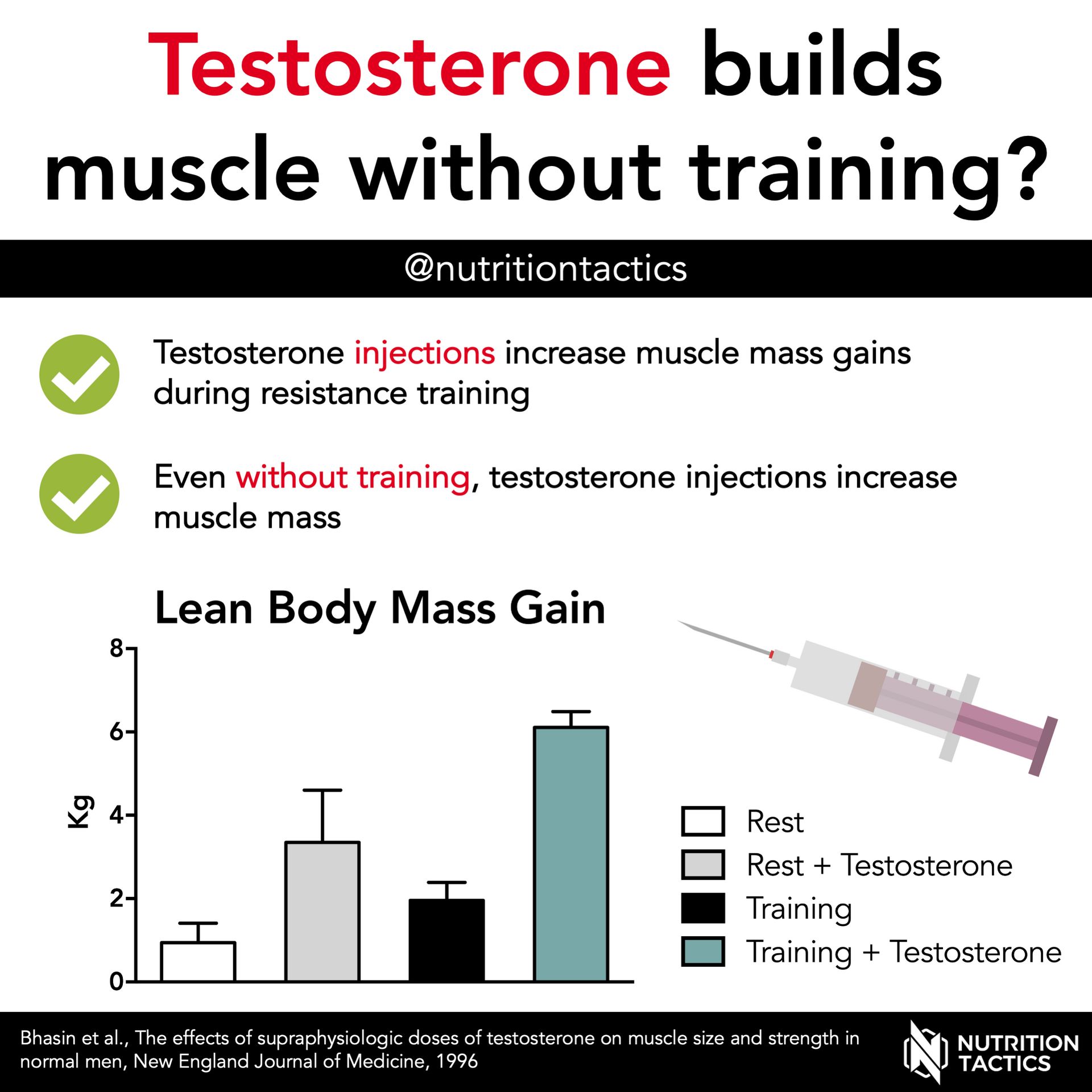
Testosterone is the primary anabolic hormone driving muscle growth. Men have 15-20 times more testosterone than women, explaining why men build muscle so much faster.
But even among men, natural testosterone varies 3-fold (normal range is 300-1000 ng/dL). A man with 900 ng/dL natural testosterone will build muscle significantly faster than a man with 350 ng/dL, even with identical training.
Women with higher natural testosterone (still far below male levels) build muscle faster than women with lower levels.
Satellite cells:
These are muscle stem cells that fuse to existing muscle fibers when you train, enabling growth and repair. People with more satellite cells build muscle faster because they have more "raw materials" for growth.
Satellite cell number is genetically determined and declines with age. Some people have 2-3 times more satellite cells than others.
Skeletal structure and tendon insertions:
Your bone structure and where tendons attach to bones affect leverage and how much weight you can lift. Better leverage means you can lift heavier weights, providing a stronger growth stimulus.
Someone with long muscle bellies and short tendons has more potential for muscle size. Someone with short muscle bellies and long tendons has less potential but often better leverage for strength.
Limb length matters too. Shorter limbs generally provide better leverage for lifting, while longer limbs create mechanical disadvantages (but look more aesthetic once muscular).
💡 Critical Context: Studies taking untrained people through identical 12-week programs show muscle gain ranging from 0 pounds to 12+ pounds. Average gain is 4-5 pounds, but 20% of people gain less than 2 pounds (non-responders) and 5% gain over 10 pounds (extreme responders). The difference is almost entirely genetic.
2. Age, Sex, and Training History: Who Has the Advantage 👴👩⏰
Age effects:
Peak muscle-building years: late teens to early 30s. Testosterone, growth hormone, and satellite cell activity are highest, and recovery is fastest.
After 30: Muscle-building capacity declines 3-8% per decade. Testosterone drops 1-2% per year after 30. Growth hormone and IGF-1 (insulin-like growth factor) decline. Satellite cell numbers decrease. Recovery takes longer.
However, resistance training remains highly effective at all ages. A 50-year-old can still build significant muscle, just slower than a 25-year-old. A 70-year-old can still gain strength and muscle, preventing age-related muscle loss.
The "newbie gains" phenomenon: Untrained people build muscle fastest in their first 1-2 years of proper training. First year: men can gain 15-25 pounds of muscle, women 8-12 pounds. Second year: half that. Third year: half again. After 3-4 years, gains slow to 2-3 pounds per year even with perfect training.

Sex differences:
Men build muscle approximately twice as fast as women due to 15-20 times higher testosterone. Realistic first-year muscle gain: men 15-25 pounds, women 8-12 pounds.
Women respond to the same training principles as men (progressive overload, sufficient volume, adequate protein). The mechanisms are identical, just slower.
Some women are genetic outliers with higher testosterone (still far below male levels) and build muscle faster than average. Some men are genetic non-responders and build slower than average women.
Training history:
Untrained (never lifted weights): Fastest potential gains, nervous system adaptations plus muscle growth.
Beginner (0-2 years training): Rapid gains, "newbie gains" phase.
Intermediate (2-5 years): Moderate gains, 5-10 pounds per year.
Advanced (5+ years): Slow gains, 2-3 pounds per year maximum.
The more advanced you are, the harder you have to work for smaller gains. An untrained person can gain muscle doing almost any program. An advanced lifter needs perfect programming, nutrition, and recovery to gain 2-3 pounds per year.
3. What You CAN Control: Training, Nutrition, and Realistic Expectations 🏋️🍗
You can't change your genetics, but you can maximize your genetic potential through controllable variables.
Training principles that work for everyone:
Progressive overload: Gradually increasing weight, reps, or volume over time. This is the most important principle. If you're not getting stronger over months, you're not building muscle.
Sufficient volume: Most people need 10-20 sets per muscle group per week for optimal growth. Too little (under 10 sets) leaves gains on the table. Too much (over 25 sets) impairs recovery.
Frequency: Training each muscle 2-3 times per week is more effective than once per week for most people.
Exercise selection: Compound movements (squats, deadlifts, bench press, rows, overhead press) build the most muscle. Isolation exercises (bicep curls, tricep extensions) supplement but don't replace compounds.
Intensity: Training close to failure (1-3 reps short of failure) is necessary for muscle growth. Easy sets don't build muscle.
Nutrition requirements:
Protein: 1.6-2.2g per kg bodyweight per day (0.7-1g per pound). More than this doesn't build more muscle. Less than this limits growth.
Caloric surplus: To build muscle, you need to eat slightly more calories than you burn. Surplus of 200-500 calories per day is optimal. Larger surpluses just add fat.
Meal timing matters less than total daily intake: Eating protein every 3-4 hours is slightly better than once daily, but total daily protein matters most.
Recovery:
Sleep: 7-9 hours per night. Growth hormone is released during deep sleep. Poor sleep impairs muscle growth and recovery.
Rest days: Training every day doesn't build more muscle, it impairs recovery. Most people need 1-2 full rest days per week.
Realistic expectations (first year of proper training):
Category | Men | Women |
|---|---|---|
Genetic elite (top 5%) | 25-35 pounds muscle | 12-18 pounds muscle |
Above average (top 25%) | 18-25 pounds muscle | 10-14 pounds muscle |
Average (middle 50%) | 12-18 pounds muscle | 6-10 pounds muscle |
Below average (bottom 25%) | 8-12 pounds muscle | 4-6 pounds muscle |
Non-responders (bottom 5%) | 3-8 pounds muscle | 2-4 pounds muscle |
These numbers assume perfect training, nutrition, and recovery. Most people fall short of genetic potential due to suboptimal training or nutrition, not genetics.
💡 Pro Tip: If you've been training properly for 12 months (progressive overload, 10+ sets per muscle per week, 1.6g+ protein per kg bodyweight) and gained less than 5 pounds as a man or 3 pounds as a woman, you're likely a genetic non-responder. You can still improve significantly, but expecting 20 pounds of muscle per year is unrealistic. Focus on strength gains and body composition rather than scale weight.
Benchmark Your Voice AI

Deepgram surveyed 400 senior leaders on voice AI to map adoption, budgets, and use cases. Compare your voice AI roadmap to $100M+ enterprises and learn where to invest next - human-like agents for customer service, task automation, and order capture - plus benchmarks to guide your 2026 plan.
Takeaways
Muscle-building capacity varies 10-fold between individuals due to genetics (muscle fiber types, myostatin levels, testosterone, satellite cells), with studies showing identical training programs producing 0-12+ pounds muscle gain over 12 weeks, 20% of people classified as non-responders gaining under 2 pounds, and 5% as extreme responders gaining over 10 pounds.
Age and sex dramatically affect muscle growth, with men building muscle twice as fast as women due to 15-20 times higher testosterone, and muscle-building capacity declining 3-8% per decade after age 30, though resistance training remains effective at all ages with realistic first-year expectations of 15-25 pounds for men, 8-12 pounds for women, halving each subsequent year.
Training (progressive overload, 10-20 sets per muscle weekly, 2-3x frequency), nutrition (1.6-2.2g protein per kg bodyweight, 200-500 calorie surplus), and recovery (7-9 hours sleep) determine whether genetic potential is reached, with most people falling short due to suboptimal programming rather than poor genetics, making these controllable factors critical for maximizing whatever genetic capacity exists.
Feedback & Sponsorship
What'd you think of this week's newsletter? Hit reply to let us know. Did we crush it? Blow your mind? We read every response.
Want your brand in front of hundreds of thousands of readers? Contact us for sponsorship opportunities [email protected]
Want more where that came from? Head to our website
How to Take Your Fitness Business Online.

Your time is limited, but your impact doesn’t have to be. Kajabi’s new guide, 30 Days to Launch: Scale Your Fitness Business Online, will show you how to grow your income and reach more clients by combining in-person and online programs.
Learn the hybrid model, follow a step-by-step launch plan, and use Kajabi’s all-in-one platform complete with courses, communities, and coaching to manage and scale your business.
Reply